

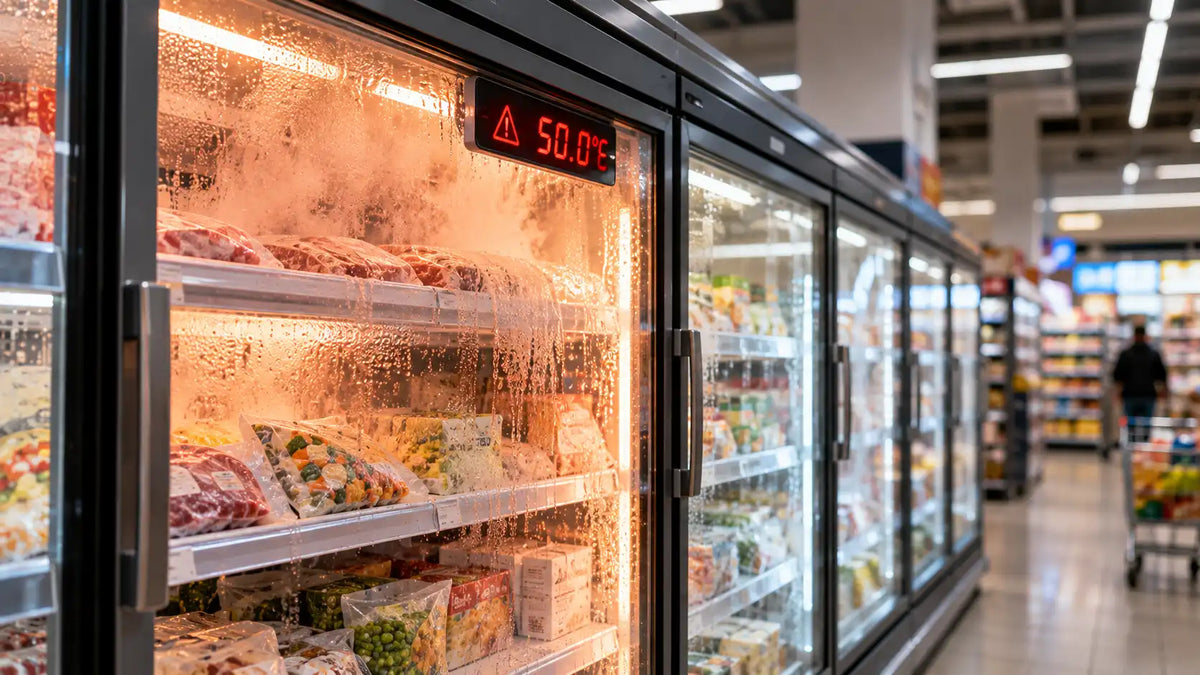
A large-scale cyberattack on the cooling systems of numerous French supermarkets caused significant damage in October 2026. Attackers manipulated networked refrigeration systems, causing food to spoil and necessitating its disposal. The incident highlights the risks associated with the increasing digitalization of refrigeration technology and why independent temperature monitoring is becoming increasingly important for businesses.
October 14, 2026 | Polarfoxx Bloxx
Cyberattack on hundreds of refrigeration systems in France
On the night of October 11–12, 2026, the cooling systems of numerous French supermarkets became the target of a large-scale cyberattack.
Unknown parties gained access to networked control systems via the internet and manipulated the refrigeration technology. According to media reports, defrost programs were activated, among other things, causing the temperatures of individual refrigerators and freezers to rise sharply over an extended period.
Temperatures of up to 50 °C were reported in some cases. Large quantities of perishable food had to be disposed of as a result.
According to French authorities, several hundred supermarkets were affected. Germany's Federal Office for Information Security (BSI) also reacted to the incident, warning of the risks posed by inadequately protected control systems accessible via the internet.
The incident makes it clear that cyberattacks no longer affect only classic IT systems. Networked technical installations are increasingly becoming a focus.
Networked refrigeration systems: convenience and risk in one
Modern refrigeration systems offer numerous advantages. Temperatures can be set centrally, operating states monitored remotely, and technical malfunctions reported automatically.
However, increasing connectivity can create new risks.
In particular, when control, temperature recording, and alarming are technically closely linked, individual malfunctions or manipulations can affect multiple functions simultaneously.
For example, if the control system of a refrigeration unit is compromised, its integrated monitoring function may also be affected.
A networked refrigeration system with integrated temperature monitoring therefore does not automatically provide independent protection against technical failures or manipulation.
Current software, protected network access, and regular security updates are indispensable. Yet even extensive IT security measures cannot eliminate every risk.
Why independent temperature monitoring makes sense
Anyone storing temperature-sensitive food must be able to rely on deviations being reliably detected.
An additional, technically independent temperature monitoring system creates an extra layer of security for this purpose.
In this setup, actual temperatures are recorded by separate sensors that operate independently of the existing refrigeration control system.
Even if a refrigeration unit is incorrectly controlled or manipulated, these sensors can continue to detect temperature changes.
However, it is not just independent measurement that is decisive.
The transmission of measured values and the alarm system should also be as independent as possible from the existing IT infrastructure.
If an external monitoring system uses the same company network as the refrigeration control system, common technical dependencies may still exist.
In our view, such independent monitoring should be part of the security concept wherever a failure of the cooling technology could cause significant loss of goods or risks to food safety.
Why Polarfoxx intentionally relies on 4G gateways
Exactly this idea is an essential component of our technical concept at Polarfoxx.
With our LoRaFOXX system, we rely on temperature monitoring that operates independently of the existing refrigeration control system.
Battery-operated temperature sensors regularly record the actual temperatures and transmit their measurements via LoRa radio to a gateway.
Polarfoxx specifically relies on 4G gateways with their own cellular connection.
As a result, data transmission takes place directly via the cellular network to the Polarfoxx Cloud. A connection to the customer's Wi-Fi or local company network is not required for this.
This offers several advantages:
-
Independent temperature measurement: Separate sensors record actual temperatures independently of the refrigeration control system.
-
Autonomous data transmission: Measured values are transmitted via a separate 4G cellular connection.
-
Independence from the local network: A failure or compromise of the customer network does not necessarily affect temperature monitoring.
-
Automatic alerting: Responsible staff can be notified in the event of critical temperature deviations.
-
Automated documentation: Recorded temperature values are available in the Polarfoxx Cloud for analysis and documentation.
Of course, a 4G gateway also requires a functioning cellular connection. Furthermore, the cloud and alarm channels must be reachable.
The decisive advantage, however, lies in the separation of the systems: a problem within the refrigeration control system or the local company network does not automatically lead to the failure of the external temperature monitoring.
More security for the entire cold chain
Cyberattacks are only one of many possible risks.
Technical defects, accidentally opened cold room doors, power outages, or incorrect settings can also cause critical temperature deviations.
For supermarkets, catering businesses, bakeries, butcher shops, food producers, and other companies with temperature-sensitive goods, such events can have significant economic consequences.
Independent temperature monitoring can help identify unusual temperature trends at an early stage.
With LoRaFOXX, measured values are automatically recorded at regular intervals. If individually defined temperature limits are exceeded, corresponding alarm messages can be triggered.
This gives responsible staff the opportunity to take action early and limit potential loss of goods.
At the same time, automatic temperature documentation supports internal operational monitoring in accordance with HACCP principles.
Conclusion: A secure cold chain needs independent control
The cyberattacks on French supermarkets illustrate that the increasing digitalization and connectivity of refrigeration technology brings not only many advantages but also new challenges.
A reliable refrigeration control system and independent temperature monitoring fulfill different tasks in this regard.
While the control system is responsible for the proper operation of the refrigeration unit, external monitoring serves as additional verification of the actual temperatures present.
Both systems should therefore operate as independently of each other as possible.
Our conviction at Polarfoxx is clear: when it comes to the security of their cold chain, companies should not rely solely on the integrated monitoring of their refrigeration systems.
With independent temperature sensors and 4G gateways, we deliberately pursue an approach that creates an additional security layer and reduces dependence on the local IT infrastructure.
Because reliable temperature monitoring means not only measuring temperatures, but also remaining capable of acting independently in the event of technical problems.
Temperature monitoring with Polarfoxx
Discover how you can use LoRaFOXX and our 4G gateways to independently monitor your refrigeration systems, detect critical temperature deviations, and automate your temperature documentation.
Share:
Bacteria, Temperature, and Hygiene: How to Keep Food Safe