

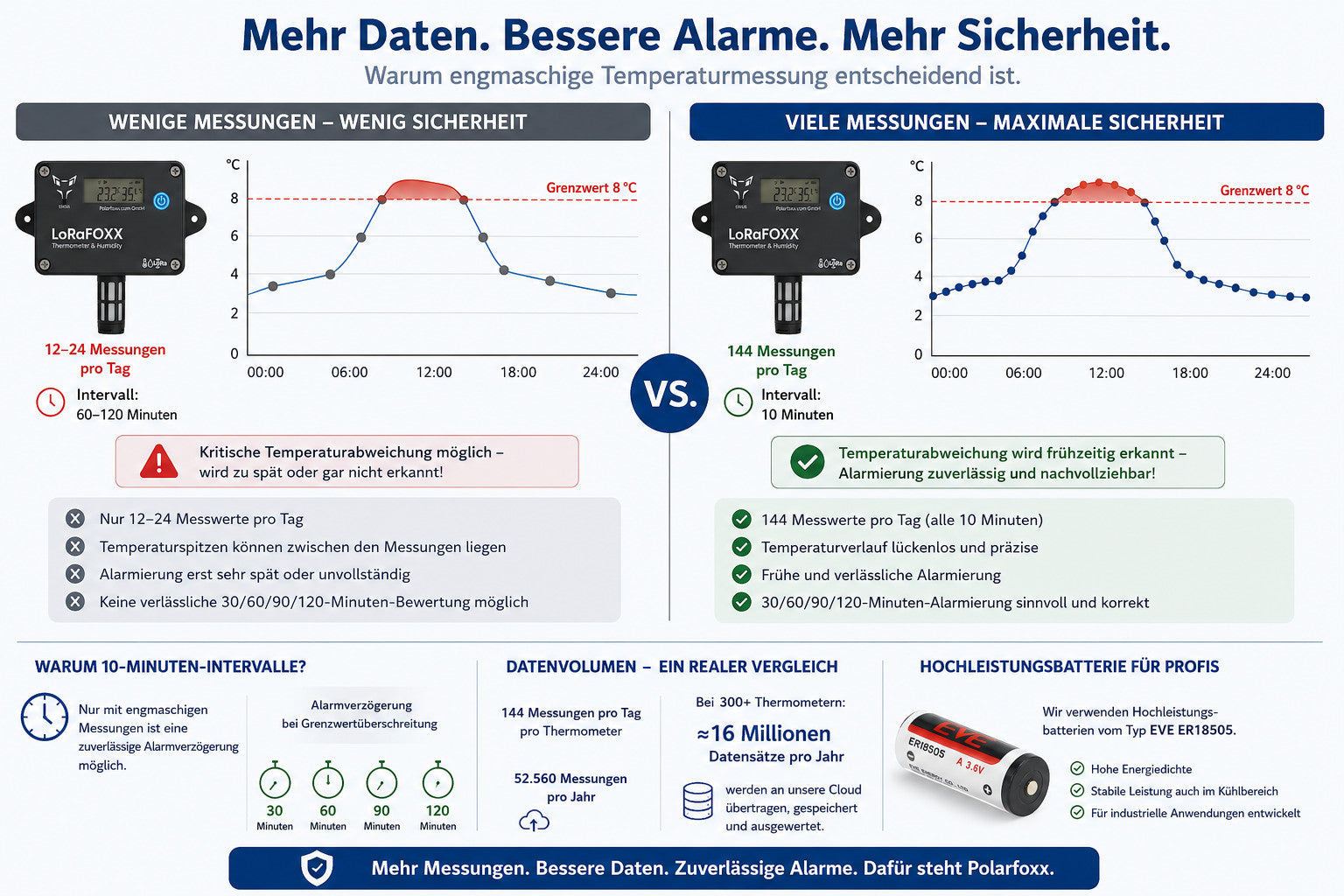
Why Close-Meshed Temperature Measurements Are More Important Than Maximum Battery Life
In professional temperature monitoring — especially for medical refrigerators, laboratories, pharmacies, food businesses, and HACCP-mandated areas — battery life is often discussed. Some systems boast battery lives of several years, sometimes even very long durations of 8 to 10 years.
At first glance, this sounds appealing. Technically, however, battery life is only one side of the coin. The crucial question is: How often is data actually measured, transmitted, and analyzed?
Because long battery life in many cases is not due to "better" monitoring, but rather to significantly fewer data transmissions.
High-Performance Batteries for Professional Use
At Polarfoxx, we use high-quality lithium high-performance batteries in our temperature data loggers, including the EVE ER18505 type.
These batteries are designed for industrial applications and offer high energy density, stable voltage, and good long-term performance. Nevertheless, physical limits apply here too: especially in cold environments, such as refrigerators, freezers, or cold storage rooms, batteries are subjected to greater stress.
Cold reduces battery performance. Towards the end of the battery's life, the voltage can drop relatively suddenly. If a device is then removed from the cold environment and stored at room temperature, the battery can temporarily "recover" and display a higher voltage again. This is not a device error, but a known physical effect of battery technology.
Therefore, the displayed battery status for devices in cold areas should always be understood as a technical orientation — not as an precisely calculated remaining value.
Why We Deliberately Measure Every 10 Minutes
Polarfoxx takes a deliberately close-meshed approach to temperature monitoring. Our thermometers measure and transmit temperature data to the cloud every 10 minutes by default.
This means:
- 144 measurements per day per thermometer
- 52,560 measurements per year per thermometer
- with 300 thermometers, already 15.768 million datasets per year
With more than 300 thermometers, around 16 million datasets per year are transmitted, stored, processed, and evaluated in our cloud.
This high volume of data is not an end in itself. It is the technical basis for reliable temperature documentation and meaningful alarming.
Why Few Measurements Per Day Are Insufficient
Some systems transmit only 12 to 24 measured values per day. This corresponds to a measurement interval of about 1 to 2 hours.
While this can achieve longer battery life, such an interval is critical for reliable temperature monitoring from our perspective.
Because temperature deviations often do not occur over many hours, but can arise relatively quickly, for example due to:
- a refrigerator door not properly closed
- frequent opening during daily operation
- technical defects in the cooling unit
- power interruptions
- incorrect loading
- defrost cycles
- location problems in the refrigerator
- cooling system failure or malfunction
If measurements are only taken every 60 or 120 minutes, a critical temperature deviation may be detected too late — or, in the worst case, not sufficiently documented between two measurement points.
Especially for medical refrigerators, vaccines, laboratory samples, or temperature-sensitive products, this is insufficient from our perspective.
Alarming Requires Data — Not Just Limit Values
Professional alarming is not just about defining an upper or lower temperature limit. The crucial factor is how quickly and reliably the system detects that a limit value has actually been exceeded.
This requires a close-meshed measurement interval.
Polarfoxx therefore offers intelligent alarm and interval logic with freely selectable delay times, for example:
- 30 minutes
- 60 minutes
- 90 minutes
- 120 minutes
These alarm delays are particularly important because not every short-term temperature deviation immediately constitutes a truly critical incident.
An example:
If a refrigerator is opened briefly, the air temperature inside often rises for a short time. The product itself is not automatically at risk. Immediate alarming for every brief door opening would lead to unnecessary false alarms.
Therefore, it makes sense to trigger alarms only when a limit violation persists for a defined period.
Why this Logic only Works with Close-Meshed Measurement
An alarm delay of 30, 60, 90, or 120 minutes only functions reliably if there are a sufficient number of measurement points within that period.
With a 10-minute interval, the following are generated within:
- 30 minutes = 3 measurement points
- 60 minutes = 6 measurement points
- 90 minutes = 9 measurement points
- 120 minutes = 12 measurement points
This allows the system to determine whether it is a short, non-critical fluctuation — or a persistent temperature deviation that must trigger a real alarm.
The situation is different for systems with only 12 to 24 measurements per day. If measurements are only taken every 1 to 2 hours, the necessary intermediate values are missing. A 30-minute alarm delay is practically not implementable in a meaningful way. Even a 60- or 90-minute evaluation would then be based on too few data points.
This means:
Without close-meshed measurement, there is no truly reliable alarm evaluation.
Battery Life Is Always a Compromise
Data transmission is the largest energy consumer in battery-powered wireless sensors. The more frequently a sensor measures and transmits data to the cloud, the more the battery is stressed.
That's why Polarfoxx communicates realistic battery lives of approximately 1.5 to 2 years — depending on ambient temperature, radio conditions, device configuration, and location.
This lifespan is the result of a deliberate technical compromise:
We do not prioritize the maximum possible battery life, but rather close-meshed, meaningful, and alarm-capable temperature monitoring.
Because a battery that lasts many years but only provides a few measured values per day does not create better security. It merely reduces the data basis.
More Data Means Better Traceability
Especially in HACCP environments, pharmacies, laboratories, and medical facilities, it's not just about recording a temperature value at some point. It's about documenting temperature trends in a traceable way.
Close-meshed data helps answer important questions:
- When did a temperature deviation begin?
- How long did it last?
- How strong was the deviation?
- Was it just a short fluctuation or a truly critical incident?
- Has the temperature stabilized again?
- Does an alarm need to be triggered?
- Is a measure subject to documentation requirements?
These questions can be answered much better with 144 measured values per day than with 12 or 24 measured values.
Conclusion: Security Arises from Data Quality
Long battery life sounds convincing at first glance. However, in professional temperature monitoring, the underlying data basis is crucial.
Polarfoxx deliberately relies on high-quality battery technology, short measurement intervals, and intelligent alarm evaluation. Our systems record temperature data every 10 minutes, thereby creating the foundation for reliable documentation, trustworthy alarming, and professional analysis in the cloud.
Because especially for sensitive products, the following applies:
It is not the longest battery life that determines the quality of a temperature monitoring system — but the reliability of the data and the ability to detect critical deviations in time.
Share:
Digital HACCP Documentation
Temperature documentation: Why manual lists are often more expensive than you think