

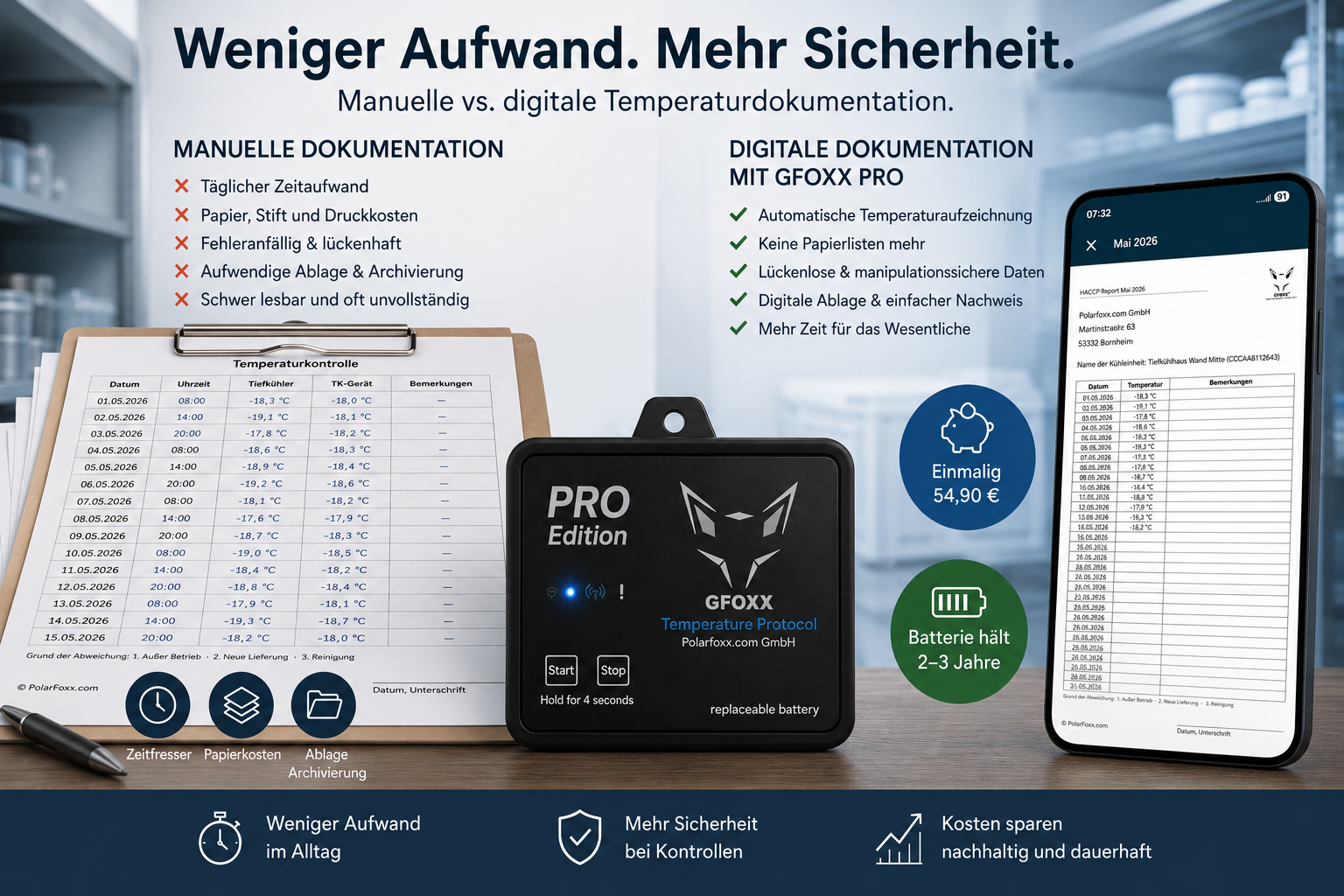
Manual vs. Digital Temperature Documentation: What Does Paper Really Cost?
In many catering businesses, bakeries, butcher shops, ice cream parlors, or smaller food establishments, temperatures are still documented manually. Employees check refrigerators, display cases, or freezers and record the values on paper lists.
At first glance, this solution seems inexpensive. After all, employees are already on site. Often, the argument of "eh-da-Kosten" (already-there costs) is used: The person is already at the business, so seemingly, recording the temperature incurs no additional costs.
In practice, however, this view is often short-sighted.
What are "Eh-da-Kosten" (already-there costs)?
The term "eh-da-Kosten" describes costs that seemingly do not arise additionally because personnel, material, or infrastructure are already available.
For manual temperature documentation, this means, for example:
The employee is already on site and can quickly record the temperature as well.
This sounds plausible. Nevertheless, every recurring task ties up working time, attention, and organizational resources.
Even small tasks become relevant if they are performed daily, multiple times a day, and over years.
Manual Temperature Documentation Costs More Than Just Paper
The actual temperature measurement often takes only a few minutes. Nevertheless, several steps are involved in manual documentation:
- Read temperature
- Enter value
- Note date and time
- Check list
- Follow up on missing entries
- File paper lists
- Retrieve documents for inspections
- Archive old lists
- Clarify incorrect or illegible entries
In addition, there are material costs for:
- Paper
- Pens
- Folders
- Printers
- Storage space
- Archiving
Each individual point seems small. In total, however, this creates ongoing administrative effort.
The Hidden Cost Factor: Employee Time
The biggest cost factor is usually not the paper, but the employee time tied up.
A simple example:
If an employee only needs 5 minutes per day for temperature control, entry, and filing, this amounts to:
- 5 minutes per day
- approx. 150 minutes per month
- approx. 30 hours per year
With multiple cooling units, multiple branches, or multiple daily checks, this effort increases accordingly.
Even if the activity is performed "on the side," it remains a recurring task that demands attention and can cause errors.
Manual Lists Are Prone to Errors
In addition to the time expenditure, there are other practical disadvantages:
- Entries are forgotten
- Values are read incorrectly
- Handwriting is difficult to read
- Lists get lost
- Documents are not properly archived
- Proof must be laboriously searched for during inspections
Especially during audits or official inspections, this can become problematic. Not only the temperature itself is relevant, but also the traceability of the documentation.
Digital Temperature Documentation as a Simple Alternative
Digital temperature data loggers can significantly reduce manual paper lists. The GFOXX Pro was developed precisely for this application: simple, cost-effective digital temperature documentation for smaller businesses.
The sensor automatically records temperature values. The data can be read out digitally and documented. This largely eliminates the daily manual recording on paper lists.
This solution is particularly interesting for:
- small catering businesses
- ice cream parlors
- bakeries
- butcher shops
- cafes
- snack bars
- small food businesses
- individual cooling units or freezers
GFOXX Pro: One-time purchase without ongoing app costs
For businesses that primarily need digital temperature documentation, the GFOXX Pro offers an affordable entry point.
The cost structure is deliberately simple:
- one-time purchase: €54.90
- free app
- no ongoing app fees
- battery life approx. 2–3 years, depending on use in refrigerator or freezer
This makes the GFOXX Pro particularly suitable for businesses that want to replace paper lists but do not need a large cloud-based system.
Example Cost Analysis
Even with just a few minutes of daily effort, a digital solution can quickly pay off.
Assuming manual temperature documentation only takes 5 minutes per day.
This corresponds to:
- approx. 30 hours of work per year
- additional paper, pens, filing, and archiving
- additional risk due to forgotten or erroneous entries
In contrast, the GFOXX Pro requires a one-time investment of €54.90 and has a battery life of approx. 2–3 years.
Even if manual activity is considered a minor sideline task, it becomes clear: recurring documentation work is not free.
Important: Documentation Yes, Alarms Only Limited
Bluetooth data loggers like the GFOXX Pro are ideal for digital temperature documentation. However, due to the limited Bluetooth range, they are not suitable for all applications as a real-time alarm system.
For larger buildings, cold storage facilities, multiple locations, or professional alarming concepts, systems based on LoRa or WLAN are often more suitable.
The GFOXX Pro is therefore particularly interesting when the focus is on simple, digital, and cost-effective temperature documentation.
Conclusion
Manual temperature documentation appears inexpensive at first glance. In practice, however, hidden costs regularly arise due to employee time, paper, filing, archiving, and potential errors.
Digital data loggers like the GFOXX Pro offer a simple way to reduce paper lists and automatically document temperature values.
For smaller businesses, this is a cost-effective alternative to larger systems:
- one-time purchase
- free app
- no ongoing app costs
- automatic temperature recording
- less paper effort
- better traceability
This makes digital temperature documentation economically attractive even for small businesses.
Share:
Battery Life Is Not Everything: Why Measurement Intervals Are Crucial
Regulation (EC) No 852/2004: The legal basis for HACCP