

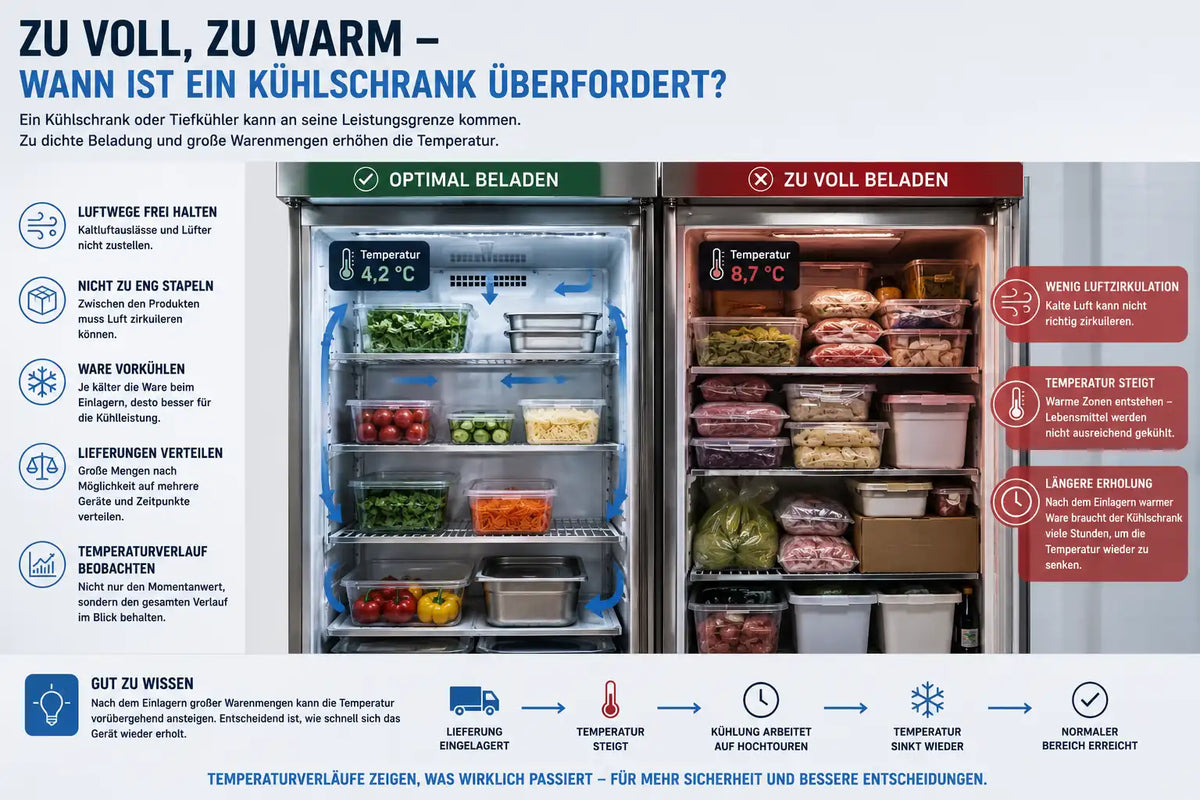
More goods mean more work for your refrigeration. And eventually, even a professional refrigerator reaches its limits.
Friday noon, just before the weekend: The new goods delivery arrives.
The refrigerator is already well-filled. Meat, vegetables, sauces, and drinks are put in – after all, everything needs to be refrigerated quickly.
Some time later, the shock:
9 °C in the refrigerator.
Is the refrigeration unit defective?
Not necessarily. The refrigerator may simply have been overwhelmed.
Problem 1: Too much product, too little air
A professional refrigerator does not cool every package individually. The generated cold must be distributed throughout the interior.
If the refrigerator is filled to the last corner, this circulation can be hindered.
It is particularly unfavorable if cartons or containers are directly in front of the areas through which the cold air enters or exits.
Then, actual temperature zones can arise:
While it might be 4 °C in one spot, for example, food just a few centimeters away can be significantly warmer.
A full refrigerator is therefore not automatically a well-cooled refrigerator.
Problem 2: Large deliveries bring warmth
It gets even more interesting with a new delivery.
Goods placed in a refrigerator do not automatically have its internal temperature.
For example, if a larger quantity of food at 10 °C enters a refrigerator at 4 °C, the refrigeration system must first remove this additional heat.
With a few packages, this is usually not a problem.
With many kilograms of goods simultaneously, the situation is different.
The refrigerator suddenly gets an additional task: It no longer just has to maintain its existing temperature, but also cool down a large quantity of new goods.
A refrigerator does not have unlimited capacity
This is easily forgotten in everyday life.
A refrigerator is designed for a specific cooling capacity. Just as a car cannot drive up a hill at any speed, a refrigeration system can only dissipate a certain amount of heat within a certain time.
The larger and warmer the quantity of newly stored goods, the longer it can take until the desired temperature is reached again.
Meanwhile, the refrigeration may already be running permanently.
It is not necessarily defective – it is simply working at its limit.
The freezer makes it even clearer
The same principle applies to a freezer – but with much larger temperature differences.
Anyone who puts larger quantities of not yet fully frozen goods into a freezer demands considerable additional cooling capacity from the system.
The freezer not only has to keep the interior at, for example, -18 °C, but also cool down the newly stored goods at the same time.
Depending on the quantity, initial temperature, and device, this can take many hours.
Particularly unfavorable:
The new goods can also warm up already frozen products.
Therefore, a single high measurement is not yet a diagnosis
Suppose your refrigerator rises from 4 °C to 8 °C after a delivery.
That sounds bad at first.
However, what happens next is crucial.
If the temperature quickly returns to the normal range, there is much to suggest a temporary overload.
If, on the other hand, it remains elevated for many hours or even continues to rise, a closer look should be taken.
Precisely for this reason, the temperature trend is often more meaningful than a single measurement.
What can you do in everyday life?
A few simple measures already help:
Keep air passages clear.
Do not block cold air outlets and fans with cartons or containers.
Do not stack to the last inch.
Air must be able to circulate between products.
Store large quantities of goods pre-cooled if possible.
The smaller the temperature difference, the less work for the refrigeration.
Distribute deliveries sensibly.
If possible, do not put the entire warm quantity of goods into a single device at once.
Monitor temperature after larger deliveries.
Don't just look at the highest value, but at how quickly the device recovers.
Temperature trends tell the real story
This is exactly where continuous temperature monitoring is particularly helpful.
You don't just see:
"At 3:00 PM it was 8.3 °C."
But for example:
12:30 PM: Delivery put away
1:00 PM: Temperature rises
2:00 PM: Peak value reached
3:30 PM: Temperature drops again
5:00 PM: Normal range reached
This allows a situation to be assessed much better.
Unusual changes also become visible: If the same refrigerator used to take two hours to recover after a delivery and suddenly needs six hours, this could be an indication that something is wrong.
Conclusion
A refrigerator or freezer can certainly be overwhelmed without being defective.
Too dense loading prevents good air circulation. Large quantities of new goods simultaneously introduce additional heat into the device.
Both can cause temperatures to rise significantly temporarily.
Therefore, the crucial question is not only:
"How warm is my refrigerator right now?"
But:
"Why has the temperature risen – and how quickly can my refrigeration unit get the situation back under control?"
Anyone who knows the temperature trend can answer precisely this question.
Share:
The refrigerator shows 5°C – but is it really 5°C?