

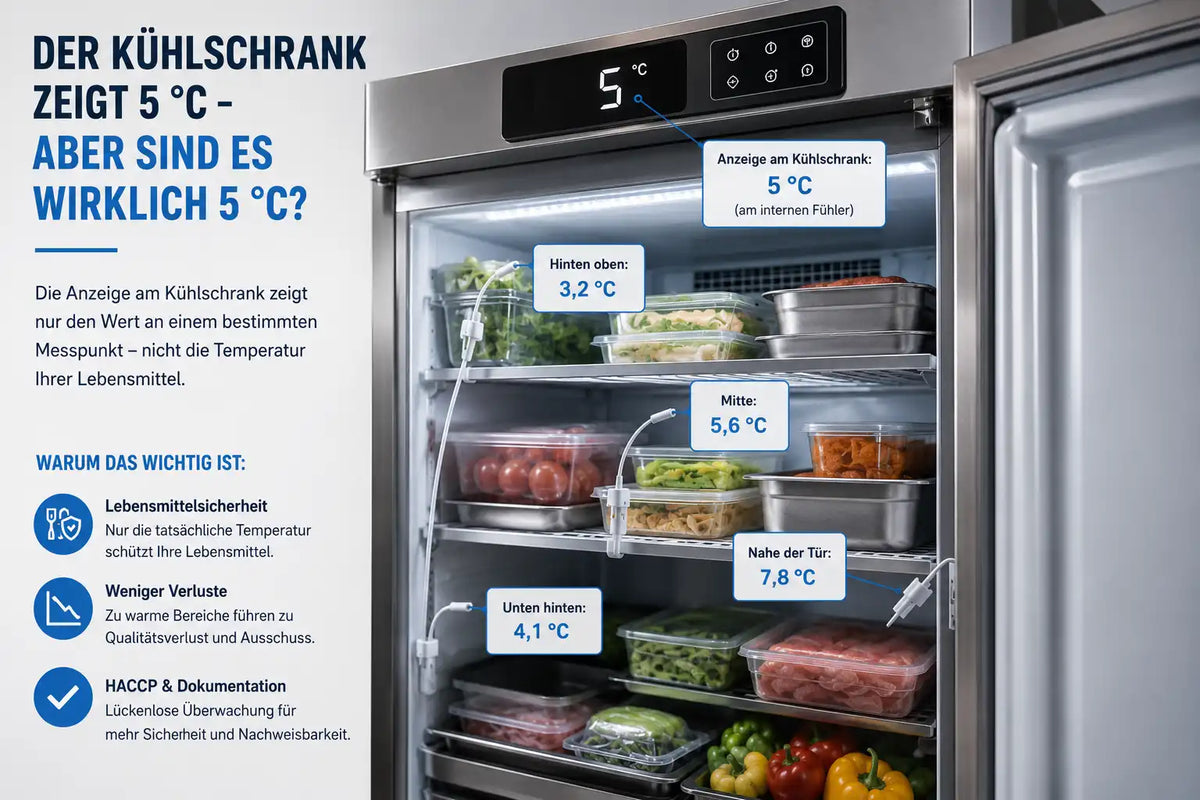
Why the display on your refrigerator doesn't always reflect the temperature of your food.
A quick glance at the display: 5°C. All in order.
Unfortunately, it's not always that simple. The temperature a refrigerator displays can differ significantly from the actual temperature of your food.
This can be crucial, especially in catering, hotels, commercial kitchens, or food retail.
A refrigerator does not have "one" temperature
Anyone who has ever taken a bottle from the back of a refrigerator knows the effect: some areas are noticeably colder than others.
This is completely normal.
The temperature depends, among other things, on:
- where the cold air enters the refrigerator,
- how fully the appliance is loaded,
- whether the air can circulate freely
- how often the door is opened,
- where the refrigerator's temperature sensor is located.
A display showing 5°C therefore initially only means: The refrigerator measures approximately this value at its own measuring point.
At another spot, temperatures of 3°C, 7°C, or even significantly higher temperatures may prevail simultaneously.
Particularly problematic: a very full refrigerator
A lot of goods in the refrigerator sounds good at first: after all, less air needs to be cooled.
In practice, however, too dense a load can become a problem.
Boxes, containers, and food can obstruct air circulation. This creates areas that are no longer sufficiently reached by the cold air.
The refrigerator itself can still be satisfied.
Its internal sensor measures, for example, 5°C and switches the cooling on and off accordingly. However, this sensor does not know that between two densely packed boxes at another point, it might already be 9°C.
Door opening also plays a role
In a professional kitchen, a refrigerator is not opened in the morning and closed again in the evening.
During operation, the door may open dozens of times.
Warm room air enters, cold air flows out. Areas near the door react quickly to this.
Therefore, the question is not only:
"What temperature do I have right now?"
Much more important is:
"How does the temperature develop throughout the day?"
A single measurement can be completely inconspicuous. Only the temperature curve shows whether a refrigerator cools down quickly after a door opening or remains too warm for a longer period.
Where should the temperature be measured?
Precisely for this reason, the position of an additional temperature sensor is important.
Measuring directly at the cold air outlet provides wonderfully low temperatures – but says little about the actual conditions in the rest of the refrigerator.
Directly at the door is also not automatically useful.
The measuring point should be chosen to be as representative as possible for the stored food.
For larger cold rooms or noticeable temperature differences, several measuring points can even be useful.
The display is still not useless
The internal temperature display of a refrigerator certainly has its justification. It helps regulate the appliance and provides a quick overview.
However, one should not rely solely on it for reliable temperature monitoring.
Independent measurement has a decisive advantage:
It controls the refrigerator from the outside.
Just as a speedometer cannot simultaneously check its own speed measurement, a refrigerator cannot independently check its own temperature measurement.
And this is precisely where automatic monitoring becomes interesting
At PolarFOXX, we therefore do not only deal with individual temperature values.
Our systems continuously record temperature curves. This makes visible what happens between two manual checks.
An example:
At 8 a.m., 5.2°C is documented.
At 6 p.m., 5.6°C is documented.
On paper, everything was perfect all day.
However, continuous recording could show that the refrigerator was significantly warmer for longer periods between 12 p.m. and 3 p.m. due to frequent door openings or unfavorable loading.
Precisely this information is missing with a single temperature check.
Conclusion
If your refrigerator displays 5°C, it doesn't necessarily mean that the temperature is actually 5°C everywhere in the refrigerator.
The crucial factors are the temperatures where your food is stored – and their development throughout the day.
Therefore, a simple test is occasionally worthwhile:
Compare your refrigerator's display with an independent measurement at different points.
Perhaps the display will be perfectly confirmed.
But perhaps you will also discover an area of your refrigerator that you hadn't considered before.
Share:
4G Gateway Instead of Wi-Fi: Less IT Risk, More Operational Reliability
Too full, too warm – when is a refrigerator overwhelmed?