

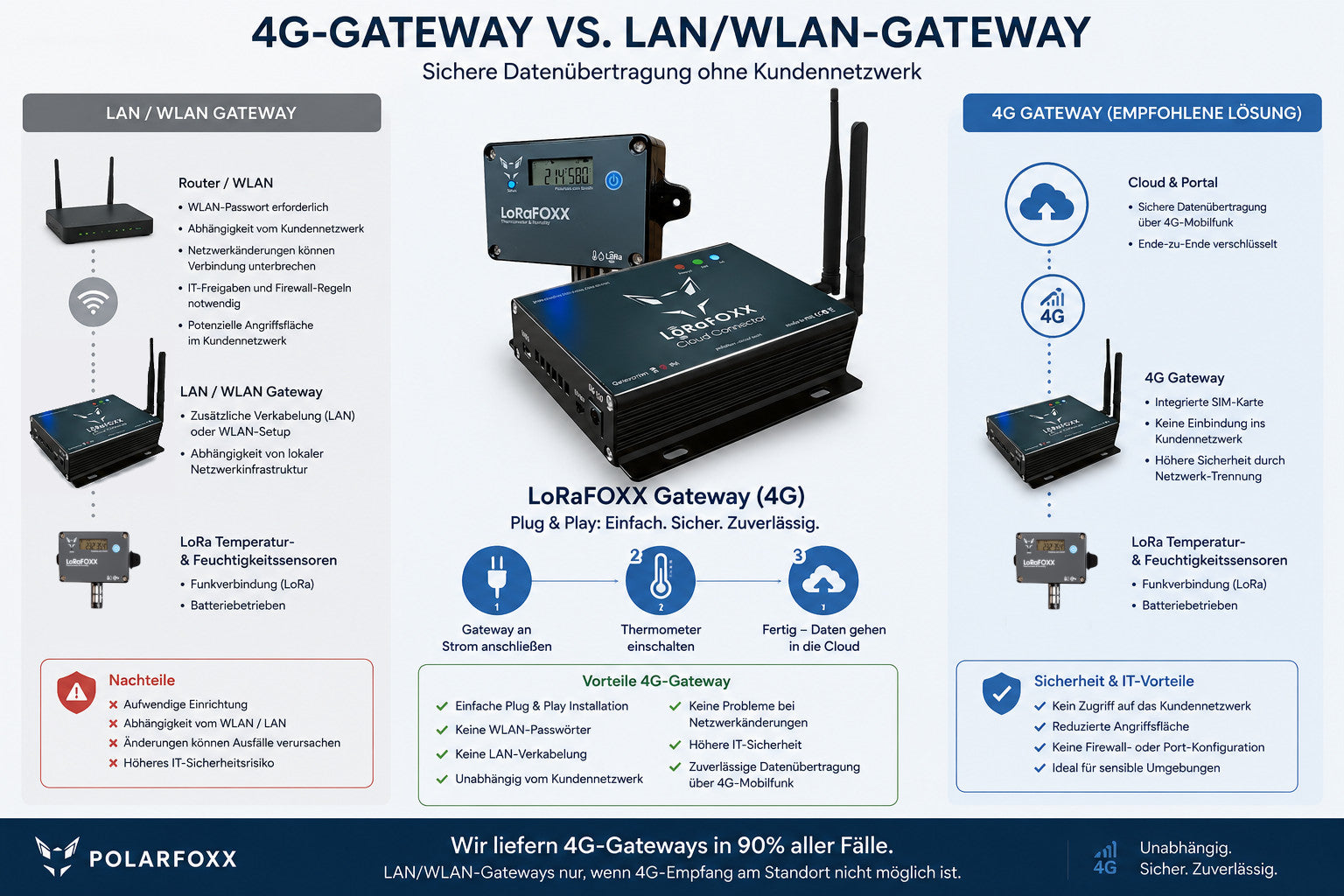
4G Gateway vs. LAN/WLAN Gateway: Why Mobile Data is Often the Better Choice for Temperature Monitoring
In digital temperature monitoring, the question often arises as to how sensors reliably transmit their data to the cloud. Technically, there are various ways to do this: via LAN, WLAN, or via a gateway with an integrated SIM card and 4G mobile connection.
At first glance, LAN or WLAN gateways seem obvious. After all, many businesses already have a network. In practice, however, it often turns out that 4G gateways are the more robust, simpler, and more secure solution, especially for professional temperature monitoring.
That's why Polarfoxx supplies 4G gateways in most cases. We only use LAN or WLAN gateways if there is absolutely no sufficient 4G reception at the location.
Plug & Play Instead of IT Project
A major advantage of a 4G gateway is its particularly easy commissioning.
The principle is deliberately simple:
- Connect gateway to power
- Turn on thermometer
- Data transfer starts automatically
No additional network configuration is required. No LAN cable. No WLAN password. No approval from internal IT. No router adjustment.
Especially in gastronomy, food retail, cold storage facilities, branch operations, or production environments, this is an enormous advantage. Installation remains quick, simple, and predictable.
No Dependency on the Customer Network
A LAN or WLAN gateway is always dependent on the existing customer network. In practice, this can lead to various problems:
- WLAN password is not known
- WLAN password is changed
- Network name is adjusted
- Router is replaced
- Firewall rules block connections
- Guest networks are unstable
- Access points are changed
- IT policies prevent external devices in the network
With a 4G gateway, these dependencies are largely eliminated. The gateway uses its own mobile connection and operates independently of the customer's local IT network.
This significantly reduces installation effort, queries, and subsequent support cases.
Particularly Important: Changes to WLAN
A common practical scenario is the change of WLAN passwords.
What is quickly done in everyday office life can become problematic with technical devices. If a WLAN password is changed, all connected devices initially lose their connection. This can include gateways, sensors, printers, POS systems, or other IoT devices.
In temperature monitoring, this can lead to data gaps.
A 4G gateway is not affected by this. It remains online independently of the customer's WLAN and continues to transmit measurement data to the cloud.
Less Cabling, Fewer Sources of Error
LAN gateways require a physical network connection. This initially sounds stable but is not always practical.
In many businesses, cold rooms, storage areas, or technical rooms are not located where network sockets are available. Additional cabling then means:
- more installation effort
- coordination with electricians or IT
- longer project durations
- higher costs
- additional sources of error
A 4G gateway, on the other hand, only needs power. This allows it to be placed much more flexibly – especially where sensor reception is optimal.
IT Security: Why a Dedicated Mobile Gateway Offers Advantages
Another important point is IT security.
From an IT perspective, every device integrated into a customer network is initially a potential additional attack vector. Even if a gateway only transmits sensor data, the connection to the local network creates a new interface.
For many companies, this means:
- Review by the IT department
- Approval processes
- Firewall rules
- Network segmentation
- Security assessments
- Documentation effort
A 4G gateway significantly reduces this complexity because it does not need to be integrated into the customer's internal LAN or WLAN.
The gateway communicates with the cloud via its own mobile connection. This leaves the customer's network untouched.
This is particularly interesting for companies with high security requirements, for example:
- Branch offices
- Food production
- Pharmaceutical and healthcare sectors
- Larger retail chains
- Public institutions
- Companies with centrally managed IT
Less Discussion with IT
In practice, not only technical security but also organizational effort is relevant.
For LAN or WLAN solutions, questions often need to be clarified:
- Is the gateway allowed into the internal network?
- Which ports are required?
- Which target addresses are accessed?
- Is a proxy used?
- Are there MAC filters?
- Is there a separate IoT network?
- Who manages later changes?
These coordinations can delay projects.
A 4G gateway significantly simplifies this process. Since integration into the customer network is not required, the solution can often be installed more quickly and with less coordination effort.
Stable Data Transmission for Critical Applications
Temperature monitoring is not a classic comfort function. It serves documentation, quality assurance, and risk reduction.
Data gaps can arise from:
- unstable WLAN
- changed access data
- router problems
- firewall changes
- network reconfigurations
- local IT disruptions
A 4G gateway reduces many of these risks because data transmission occurs via a separate connection.
This independence is a great advantage, especially for HACCP documentation, cold chain monitoring, and alarming.
When LAN or WLAN Can Still Make Sense
LAN or WLAN gateways can be useful if there is insufficient 4G reception at the location.
This can occur, for example, in:
- basement rooms
- heavily shielded buildings
- underground storage facilities
- very massive industrial buildings
- areas without mobile coverage
In such cases, a LAN or WLAN gateway can be a suitable alternative.
However, our standard approach remains: If 4G is available, a 4G gateway is in many cases the simpler and more robust solution.
Conclusion
4G gateways offer clear advantages over LAN or WLAN gateways in professional temperature monitoring.
They enable:
- simple plug-and-play installation
- no WLAN passwords
- no LAN cabling
- no dependency on the customer network
- less support effort
- lower risks due to network changes
- simpler IT security assessment
- quick commissioning
That's why Polarfoxx primarily relies on 4G gateways with integrated SIM cards in most cases. LAN or WLAN gateways are mainly used when there is insufficient 4G reception at the location.
For many businesses, this means: less effort, fewer technical dependencies, and more reliable data transmission for digital temperature monitoring.
Share:
Gastronomy in Transition: Humans, Robots, and the Importance of the Cold Chain
The refrigerator shows 5°C – but is it really 5°C?