

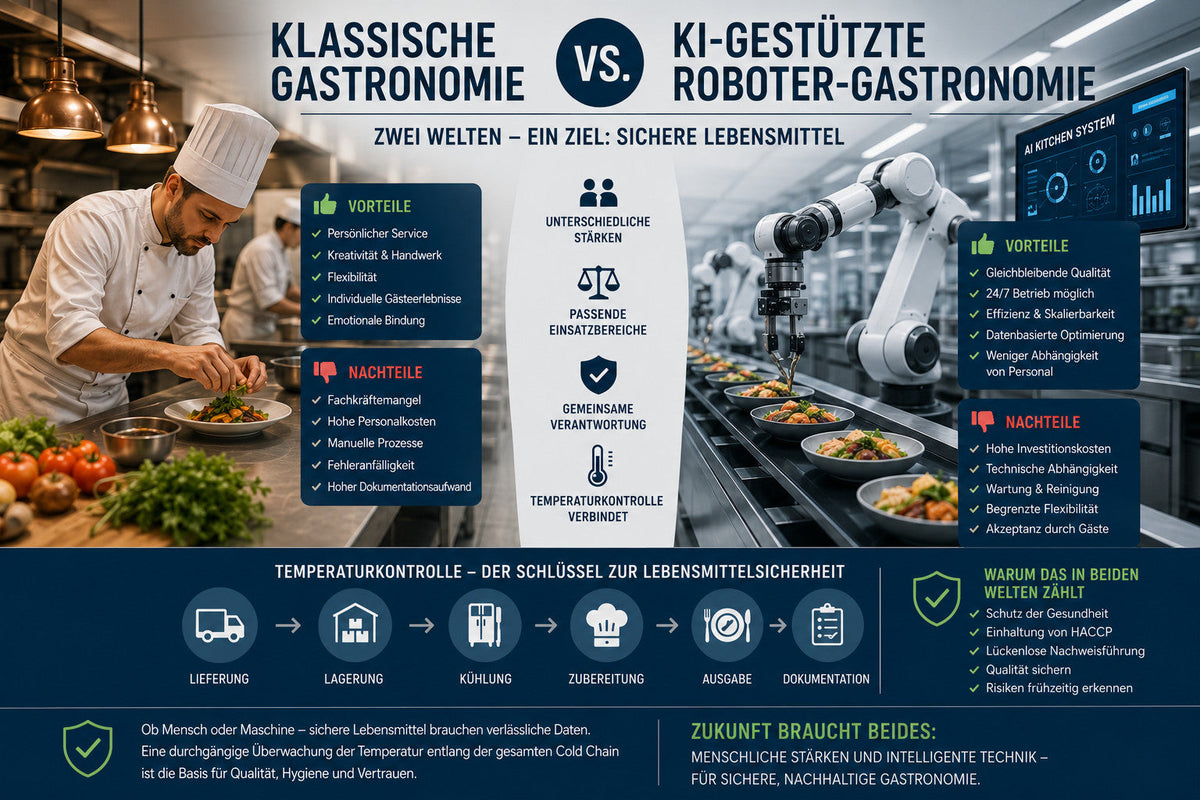
*Image generated by AI for visual representation.
Traditional Gastronomy vs. AI Robots: Why Temperature Control Remains Crucial in Both Worlds
The food service industry is changing. Alongside traditional restaurants, bakeries, butcher shops, canteens, and large-scale kitchens, increasingly automated concepts are emerging where AI, robotics, and software take over central tasks in food preparation.
A well-known example is the Circus Group, which is developing the CA-1, an autonomous AI robotics system for automated food production. The system is described as a fully autonomous solution for meal preparation and is intended for use in offices, canteens, supermarkets, mobility locations, hotels, hospitals, care facilities, and educational institutions, among others, depending on the area of application. Circus describes the CA-1 as a compact robotic kitchen with AI-powered control, data analysis, and central fleet management.
But does this mean that traditional gastronomy is losing importance? Not necessarily. Rather, two different operating models with different strengths are emerging. What connects both: neither works without a secure cold chain, hygiene, and temperature control.

Traditional Gastronomy: Craftsmanship, Hospitality, and Flexibility
Traditional gastronomy thrives on people. Chefs, service staff, operations managers, and owners shape the experience. Taste, atmosphere, advice, creativity, and personal hospitality cannot be fully automated.
Traditional gastronomy is particularly strong where individuality is required:
- à la carte restaurants
- fine dining
- family-run businesses
- regional cuisine
- catering with individual requirements
- bakeries, butcher shops, and delicatessens with a focus on craftsmanship
- gastronomy with personal service
Humans recognize situations, react flexibly, improvise when problems arise, and create an emotional bond with the guest.
Advantages of Traditional Gastronomy
Traditional gastronomy offers clear strengths:
- personal hospitality
- artisanal quality
- creative menu development
- flexible response to special requests
- regional and seasonal adaptation
- emotional customer loyalty
- individual responsibility on site
Especially in experiential dining, personal service, or high-quality concepts, the human element remains a central success factor.
Disadvantages of Traditional Gastronomy
At the same time, traditional gastronomy is under high pressure:
- shortage of skilled workers
- rising personnel costs
- fluctuating quality with changing staff
- high documentation effort
- manual processes
- error susceptibility in routine tasks
- high burden of hygiene, HACCP, and control obligations
Many tasks in gastronomy are repetitive, time-critical, and require documentation. These include temperature controls, cleaning records, and goods inward inspections.
AI-Powered Robot Gastronomy: Efficiency, Standardization, and Scalability
Automated food concepts take a different approach. AI-powered robotics systems aim to standardize processes, relieve staff, and consistently produce meals.
Such systems are particularly interesting for locations with high throughput, long opening hours, or standardized meals:
- canteens
- supermarkets
- airports
- train stations
- gas stations
- hospitals
- care facilities
- universities
- large corporate locations
- quick-service concepts
The Circus Group names areas of application for the CA-1 such as Workplace, Mobility, Retail, Hospitality & Care, and Institutions. This shows that robotic gastronomy is particularly interesting where reliable, scalable, and repeatable food production is required.
Advantages of AI-Powered Robot Gastronomy
Automated systems can offer significant advantages in certain areas:
- consistent process quality
- standardized preparation
- 24/7 operation possible
- reduced dependence on kitchen staff
- data-based optimization
- central control of multiple locations
- plannable workflows
- less manual routine work
- potentially smaller space requirements
Circus describes the CA-1 with features such as autonomous production, flexible menu, 24/7 operation, data-based optimization, and central fleet control management.
Disadvantages and Limitations of Automated Gastronomy
Despite all advantages, robotics does not automatically replace all gastronomy.
Limitations arise, for example, with:
- emotional guest experience
- individual consultation
- spontaneous creativity
- complex special requests
- artisanal diversity
- guest acceptance
- technical maintenance
- investment costs
- dependence on software, sensor technology, and availability
- cleaning, refilling, and quality control
Even autonomous systems still require people: for filling, maintenance, cleaning, troubleshooting, quality control, and organization. Circus also describes operator-related tasks for its systems, such as loading ingredients, assembly processes, incident handling, and quality assurance.

Who has a right to exist where?
The crucial question is not: "Robot or human?"
Rather:
Which system suits which application?
Traditional gastronomy is particularly strong in:
- experiential dining
- personal service
- high-quality cuisine
- individual dishes
- regional concepts
- artisanal production
- customer loyalty through personality
Robot gastronomy is particularly strong in:
- standardized dishes
- high repeatability
- long operating hours
- staff shortages
- locations with limited space
- canteen and supply concepts
- branch and scaling models
- data-driven process optimization
Both models can coexist. In many areas, hybrid concepts will emerge: humans take on creative, organizational, and service-oriented tasks, while automation supports repetitive, standardized processes.
Why Temperature Control Remains Indispensable in Both Worlds
Whether traditional kitchen or AI robot: food remains food.
Raw materials, chilled ingredients, frozen products, prepared meals, and sensitive components must be stored and processed safely. Maintaining the cold chain is a central component of food safety.
Temperature deviations can arise from:
- faulty cooling
- open doors
- power outages
- incorrect storage
- delayed goods receipt
- technical malfunctions
- excessive holding times
- insufficient process control
In traditional operations, risks often arise from manual processes and time pressure. In automated systems, risks tend to arise from technical dependencies, sensor technology, filling processes, storage logistics, and interfaces.
In both cases: what is not monitored and documented can be difficult to trace in an emergency.
Cold Chain: From Goods In to Dispensing
The cold chain does not start in the refrigerator. It encompasses the entire journey of a food item:
- delivery and goods receipt
- interim storage
- cold or freezer storage
- preparation
- processing
- dispensing or sale
- documentation and record-keeping
Especially for sensitive foods, it is important to avoid critical temperature ranges and detect deviations early.
This applies to traditional gastronomy as well as to robotic food systems.
Automation Even Requires Particularly Good Sensor Technology
The more automated a process is, the more important reliable measurement data becomes.
A robot can only work safely and efficiently if the underlying processes are controlled. This includes:
- temperature data
- storage conditions
- cleaning status
- maintenance information
- ingredient availability
- process times
- deviations and alarms
Temperature control thus does not become less important, but rather more important. Because automated systems require robust data to operate reliably, auditably, and safely.
Digital Temperature Monitoring as a Common Denominator
Digital temperature monitoring supports both worlds.
In traditional operations, it helps to:
- Reduce paper lists
- Relieve manual controls
- Avoid data gaps
- Improve HACCP documentation
- Make deviations traceable
In automated operations, it helps to:
- Safeguard processes data-based
- Monitor technical systems
- Make central locations comparable
- Maintain quality standards scalably
- Detect malfunctions early
Thus, temperature monitoring becomes a connecting element between traditional gastronomy and modern food robotics.
HACCP remains mandatory even with AI and robotics
AI and robotics can improve processes, but they do not replace the responsibility for food safety.
Even automated food systems must be operated, cleaned, monitored, and documented hygienically. The more processes are automated, the more important clear digital proof becomes.
This particularly applies to:
- Temperature profiles
- Cleaning documentation
- Deviations
- Maintenance events
- Responsibilities
- Batch and process data
- Alarm histories
Automation can support HACCP processes. However, it does not make them superfluous.
Video: Polarfoxx short introduction
Finding harmony
Traditional gastronomy and AI-supported robot gastronomy are not necessarily contradictory. They fulfill different tasks.
Traditional gastronomy remains strong where craftsmanship, hospitality, creativity, and personal experience are crucial. Robot gastronomy can offer advantages where standardization, scalability, 24/7 availability, and data-driven efficiency are required.
Both models have their raison d'être.
However, what remains the same in both worlds: Food safety essentially depends on controlled processes. This includes hygiene, documentation, and above all, reliable temperature control along the entire cold chain.
Share:
Last Mile, High Stakes: Why Temperature Control in Deliveries is Critical
4G Gateway Instead of Wi-Fi: Less IT Risk, More Operational Reliability