

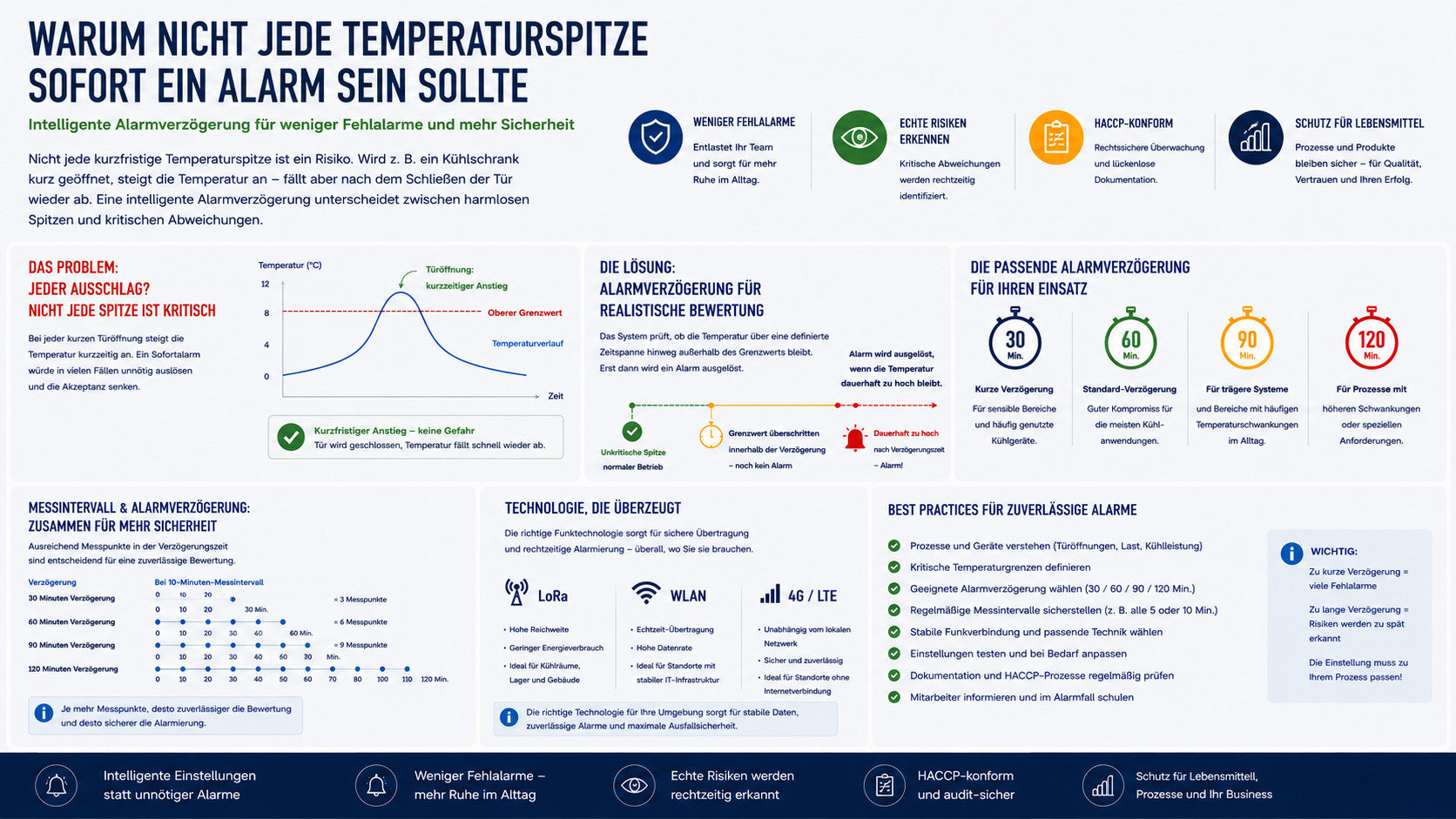
Why Not Every Temperature Spike Should Immediately Trigger an Alarm
Digital temperature monitoring isn't just about detecting temperature deviations. The key is to identify the right deviations at the right time.
This is because not every short-term temperature spike automatically poses a risk to food, medicines, or other temperature-sensitive products. If a refrigerator door is briefly opened, the measured air temperature often rises quickly. Once the door is closed again, the temperature usually returns to the normal range.
If a system were to immediately trigger an alarm for every brief temperature spike, it would generate many unnecessary false alarms. This burdens employees, leads to alarm fatigue, and in the worst case, can result in genuine critical deviations no longer being taken seriously.
Therefore, a well-configured alarm delay is a crucial component of professional temperature monitoring.
What is a temperature spike?
A temperature spike is a short-term increase or decrease in the measured temperature.
In refrigeration and freezing areas, such spikes often occur due to normal operational processes, for example:
- Opening a refrigerator door
- Storing new goods
- Removing products
- Defrost cycles
- Cleaning
- Brief load changes in refrigeration technology
- Relocating food
- Air movement in the unit
Air temperature sensors, in particular, often react faster than the actual product. This means that the air in the refrigerator can briefly become warmer, while the goods themselves remain adequately cooled.
Why an immediate alarm is not always sensible
An immediate alarm initially sounds safe. In practice, however, it can be problematic.
If an alarm is triggered every time a door is briefly opened, many notifications are quickly generated that do not pose a real danger. Employees have to react, check, acknowledge, or document – even though the temperature would have normalized after a short time.
This leads to several problems:
- Unnecessary interruptions in workflow
- Increased burden on employees
- Lower system acceptance
- Alarm fatigue
- More ignored notifications
- Less attention to genuine disruptions
A good temperature monitoring system must therefore be able to distinguish between a brief, non-critical spike and a sustained temperature deviation.
Alarm Delay: The Important Difference
An alarm delay means that the system does not trigger an alarm immediately when a threshold is exceeded. Instead, it checks whether the temperature remains outside the permissible range for a defined period.
Example:
A refrigerator has an upper limit of +8 °C. When the door is opened, the air temperature briefly rises to +10 °C. After a few minutes, it drops back to +5 °C.
In this case, an immediate alarm would not be useful.
However, if the temperature remains above the limit for an extended period, this may indicate a real problem:
- Door not properly closed
- Refrigeration unit failed
- Goods stored too warm
- Insufficient cooling capacity
- Power supply interrupted
- Technical defect present
This is precisely why an alarm delay is important.
30, 60, 90 or 120 minutes: Why different delays are useful
Not every operation and not every refrigeration unit requires the same alarm delay. The appropriate setting depends on the area of application, the product, the refrigeration technology, and the operating procedures.
Typical delay times can be, for example:
30 minutes
Suitable for sensitive areas where a quick response is important. For example, for small refrigeration units, frequently used refrigerators, or products with strict temperature requirements.
60 minutes
A good standard value for many refrigeration applications. Brief door openings or normal operating procedures do not immediately trigger an alarm, but genuine deviations are detected promptly.
90 minutes
Useful for slower systems, larger cold rooms, or areas where short-term temperature fluctuations occur more frequently.
120 minutes
Suitable for processes where short-term fluctuations are normal or where the product temperature reacts significantly slower than the air temperature. However, it must be carefully checked whether this delay matches the risk.
Important: An alarm delay should not be chosen arbitrarily. It should match the respective process and the risk of the stored products.
The Connection Between Measurement Interval and Alarm Delay
An alarm delay only functions reliably if the system records sufficient measurement points.
If a sensor only measures a few times a day, it cannot accurately assess whether a temperature deviation was brief or permanent.
Example:
With a measurement interval of 10 minutes, within an alarm delay of:
- 30 minutes: 3 measurement points
- 60 minutes: 6 measurement points
- 90 minutes: 9 measurement points
- 120 minutes: 12 measurement points
This allows the system to evaluate the temperature curve much better.
If, however, a system only measures once an hour or only a few times a day, large gaps arise. Then a critical deviation can be detected too late or incorrectly assessed.
Therefore, the measurement interval and alarm delay always belong together.
Why close-meshed measurement intervals are important
Close-meshed measurement intervals enable a realistic evaluation of the temperature curve.
They help to identify:
- Whether it's just a brief door opening
- Whether the temperature quickly drops again
- Whether a limit value is permanently exceeded
- Whether a refrigeration unit is slowly failing
- Whether recurring temperature problems occur
- Whether certain times or processes are critical
For pure documentation, larger measurement intervals may suffice in some cases. However, for reliable alarming, close-meshed data is significantly more important.
An alarm function is only as good as the data basis on which it operates.
LoRa, WLAN, and 4G: Technology must match the application
Wireless technology also plays a role.
Various technologies are often used in temperature monitoring:
- Bluetooth data loggers
- WLAN sensors
- LoRa sensors
- Gateways with LAN, WLAN or 4G
- Mobile-based systems
For pure temperature documentation, simple data loggers may be sufficient. However, if alarming, remote monitoring, and continuous transmission are desired, the wireless technology must function reliably.
Refrigerated rooms, cold storage facilities, or massive building structures can make wireless connections difficult. Therefore, not only the sensor is crucial, but the entire system consisting of measurement interval, wireless technology, gateway, cloud, and alarming.
Avoiding False Alarms, Recognizing Real Risks
The goal of good temperature monitoring is not to trigger as many alarms as possible.
The goal is to trigger the right alarms.
A system should not overload employees with unnecessary messages, but rather specifically point out real risks.
This requires:
- Appropriate limit values
- Sensible alarm delays
- Sufficient measurement points
- Stable wireless connection
- Clear escalation paths
- Understandable documentation
- Regular review of settings
Only then can a system be created that employees trust and that is taken seriously in an emergency.
HACCP: Alarming must fit the practice
The HACCP concept is about identifying, evaluating, and implementing appropriate measures for risks. Temperature monitoring is an important part of this.
But HACCP is also practice-oriented. Not every brief air temperature spike is automatically a critical control point. The decisive factor is whether a real risk to the product arises.
Therefore, limit values and alarm delays should be sensibly defined within the framework of the operational HACCP concept.
Important questions are:
- What products are stored?
- How sensitive are these products?
- How often is the refrigeration unit opened?
- How quickly does the temperature recover?
- What is the maximum duration an deviation can last?
- Who is informed in case of an alarm?
- What measures are documented?
A digital solution can support these processes, but it does not replace the expert evaluation within the operation.
Practical example: Refrigerator door
A typical example is the refrigerator door.
If it is briefly opened, the air temperature rises quickly. This is normal. When it is closed again, the temperature usually drops again.
However, if the door remains open or does not close properly, the temperature will rise permanently. That's when the system needs to react.
An intelligent alarm delay therefore helps to distinguish between everyday occurrences and a real problem.
Why this also affects battery life
Measurement intervals and wireless transmission affect the battery life of a sensor. The more frequently measurements are taken and transmitted, the higher the energy consumption.
Therefore, a good system is always a technical compromise between:
- Battery life
- Measurement interval
- Wireless range
- Alarm speed
- Reliability
- Operating temperature
- Data quality
A very long battery life sounds attractive. However, if it is only achieved through infrequent measurements, the alarm quality can suffer.
For professional temperature monitoring, therefore, it is not the longest battery life that is decisive, but the appropriate balance.
Conclusion
Not every temperature spike should immediately trigger an alarm. Brief increases due to door openings, storing goods, or normal operating procedures are unavoidable in many refrigeration areas.
The decisive factor is whether the temperature remains permanently outside the permissible range.
A sensibly configured alarm delay reduces false alarms, relieves employees, and ensures that real risks are taken seriously. For it to function reliably, the system needs sufficient measurement points, stable wireless technology, and appropriate limit values.
Professional temperature monitoring therefore does not mean: alarming immediately at every spike.
Professional temperature monitoring means: triggering the right alarm at the right time.
Share:
Temperature monitoring is not a duty – it's an investment that pays off
Cooling system vs. Building construction – Where do the actual energy costs arise?