

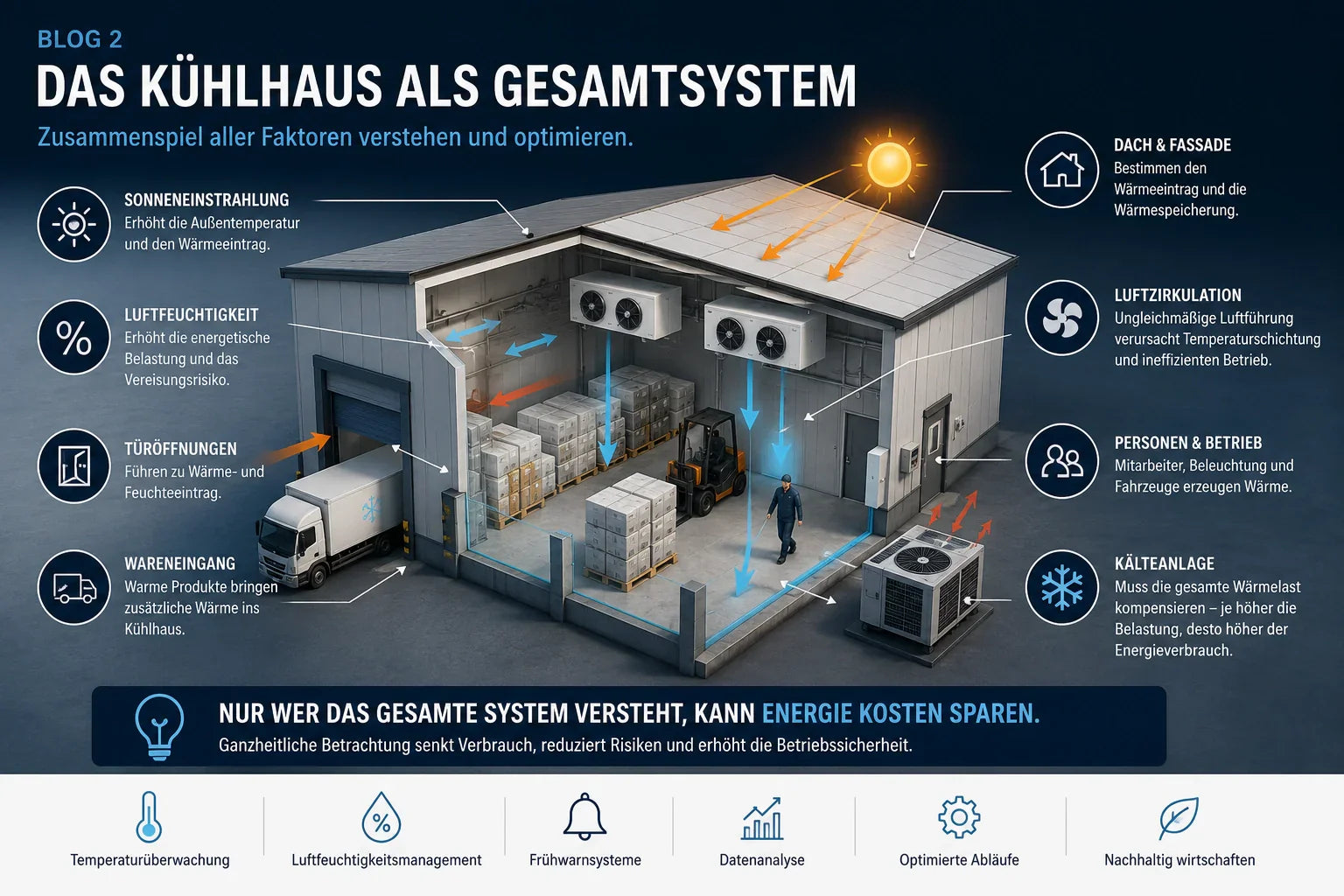
The Cold Storage as a Complete System – Why Individual Components Should No Longer Be Considered in Isolation
Part 2 of the series: The refrigeration system is not the problem
When facing issues with cooling performance, attention almost automatically turns to the refrigeration system.
Is there enough refrigerant?
Is the evaporator iced up?
Is the condenser dirty?
Is the compressor defective?
These questions are important – but often fall short.
Because a modern cold storage facility is not a single technical device. It is a complex thermal overall system in which numerous factors interact simultaneously.
Those who only look at the refrigeration system often overlook the actual causes of rising temperatures and high energy costs.
Every heat source stresses the cooling system
A refrigeration system does not remove cold.
It removes heat.
Every additional heat source therefore directly increases the necessary cooling capacity.
In this process, many small influences often add up to a considerable overall load.
These include, for example:
- Solar radiation on the roof and exterior walls
- heated production or storage halls
- frequently opened doors
- incoming goods with warm products
- forklifts and industrial trucks
- employees in the cold room
- lighting
- motors and machines
- ventilation systems
- high humidity
- insufficient air circulation
Each individual factor initially seems small.
Together, however, they can significantly increase energy demand.
The interplay is decisive
In many businesses, problems are viewed in isolation.
If the temperature rises, the refrigeration system is checked.
If electricity consumption increases, a new compressor is discussed.
However, all components influence each other.
An example:
A hall temperature rises by only a few degrees due to a poorly insulated roof.
This increases the heat input into the cold storage.
The refrigeration system runs longer.
The condenser releases more heat into the hall.
This further heats up the hall.
The refrigeration system has to perform even more.
A cycle is created that intensifies throughout the day.
Humidity is often underestimated
Not only temperature determines the load on a refrigeration system.
Humidity also plays a central role.
Warm, moist air brings significantly more energy into the cold room than dry air.
This moisture condenses on evaporators.
Ice forms.
Heat transfer deteriorates.
Defrost cycles become more frequent.
Cooling capacity decreases.
Energy consumption increases.
Therefore, simple temperature monitoring is often no longer sufficient.
Only the combination of temperature and humidity allows for a sound assessment of the actual load.
Data replaces assumptions
Many decisions are still made by feel.
"In summer, the system just runs a bit longer."
"It's always been that way."
But modern sensor technology often paints a completely different picture.
Only when temperature, humidity, and their temporal progression are continuously recorded do correlations become visible.
For example:
- Does the hall temperature rise unusually sharply already in the morning?
- What impact does direct solar radiation have?
- How does the temperature change after incoming goods?
- Which areas of the building are consistently more critical than others?
- What impact do frequent door openings have?
- How quickly does the cold storage recover after being loaded?
This information leads to valuable insights for technology, operations, and investment decisions.
The future belongs to intelligent buildings
In the coming years, refrigeration technology will continue to change.
Larger compressors will not be the deciding factor for energy efficiency.
Crucial will be how intelligently buildings monitor and control their thermal processes.
Modern systems detect anomalies early.
They identify increasing heat loads.
They show trends over weeks and months.
And they make it possible to objectively evaluate measures before unnecessary investments are made.
Conclusion
A cold storage facility consists not only of an evaporator, compressor, and condenser.
It is the interplay of building, insulation, solar radiation, humidity, goods movement, air guidance, and refrigeration technology.
Only when all these factors are considered together can energy consumption, operating costs, and outage risks be sustainably reduced.
The most important insight is therefore:
Do not optimize individual components – but understand the entire thermal system.
Precisely this paradigm shift will decide in the coming years which cold storage facilities operate economically and which will permanently struggle with unnecessarily high energy costs.
Share:
Alarm Delay for Temperature Monitoring: Fewer False Alarms, More Security
The cooling system isn't the problem – it's the building