

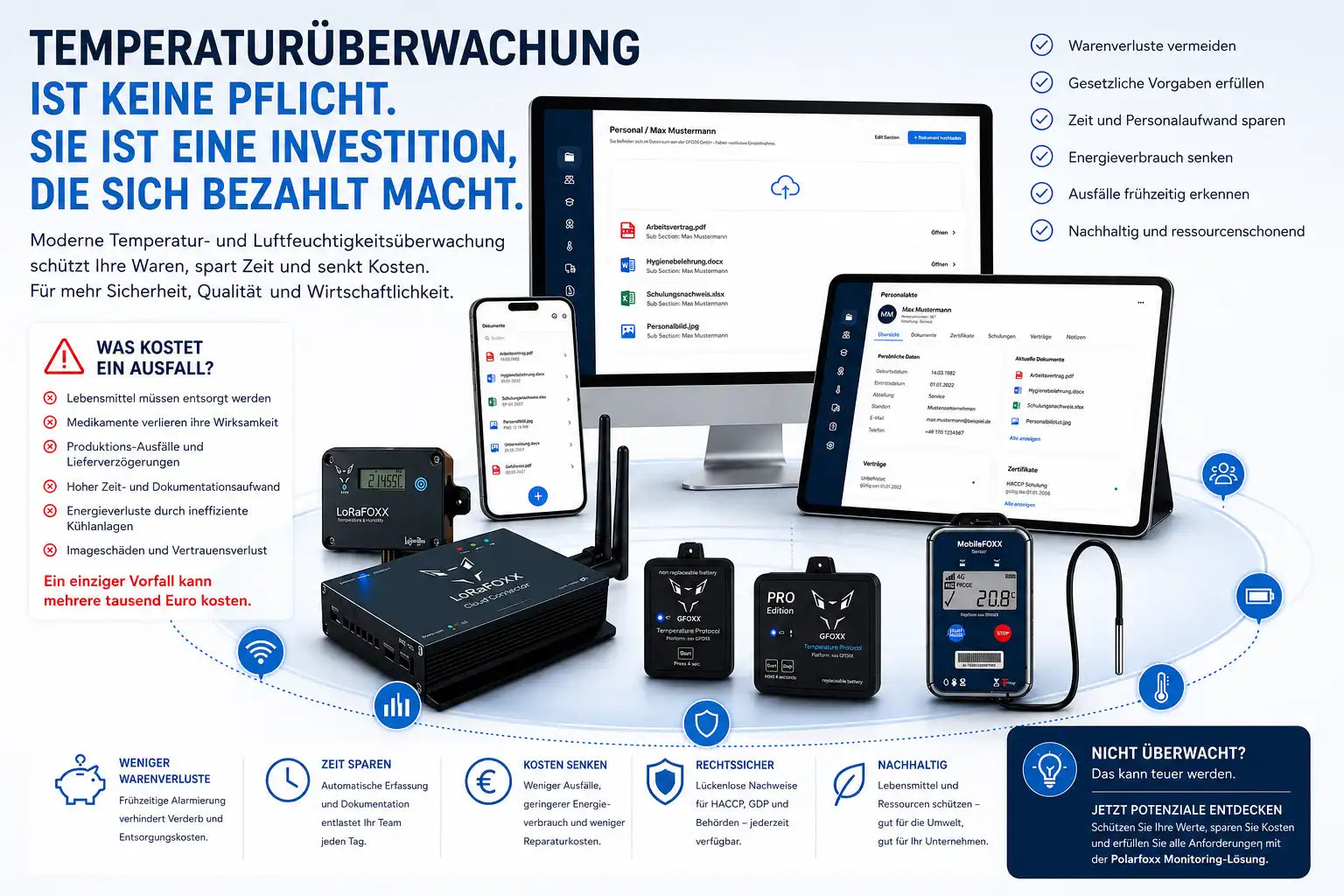
Why modern temperature and humidity monitoring not only protects companies legally but can also save them a lot of money.
When companies consider temperature monitoring, there is usually a specific trigger: the health department requires temperature logs, HACCP mandates controls, or proof must be provided during an audit.
The result: temperature monitoring is often viewed as a necessary obligation – another cost that simply has to be met.
But precisely this view falls short.
Because modern temperature and humidity monitoring is now far more than a digital version of the classic thermometer. Used correctly, it helps to avoid product loss, save energy, relieve staff, and detect technical problems early.
In other words:
A good monitoring system costs money – but can save significantly more money.
The real question is not: What does the system cost?
Many companies initially compare acquisition costs or monthly fees.
This is understandable.
However, from an economic perspective, a different question should be central:
What does a single damage incident that I could have prevented cost me?
A cold storage room fails at night.
A refrigerator doesn't close properly.
A fuse trips.
The refrigeration system operates at its capacity limit during a heatwave.
Often, no one notices anything at first.
Only the next morning is it discovered that the temperature was outside the permissible range for hours.
Then the actual cost calculation begins.
Product losses are just the tip of the iceberg
Most people first think of the value of the goods.
But in fact, significantly more costs arise.
If food has to be disposed of, the following are also lost:
- Purchase costs
- Transport costs
- Storage costs
- Cooling energy
- Working time for preparation
- Documentation
- Disposal costs
- Costs for replacement procurement
In the worst case, supply bottlenecks or revenue losses are added.
A single incident can quickly cost several thousand euros.
Yet the problem could often have been avoided.
Food waste costs more than just money
Every food item that has to be disposed of was previously produced, processed, transported, cooled, and stored.
For every kilogram that ends up in the trash, energy, water, raw materials, and working time were invested.
A functioning cold chain therefore not only protects the value of the goods.
It also helps to conserve valuable resources and reduce food waste.
Sustainability and economic efficiency are not mutually exclusive here – they complement each other.
Medication cannot simply be re-cooled
The situation is even more critical in healthcare.
Doctor's offices, hospitals, pharmacies, or laboratories often store medications, vaccines, or sensitive laboratory samples within precisely defined temperature ranges.
If this range is exceeded, it often cannot be unequivocally proven that the quality has been maintained.
In doubt, there is only one consequence:
The products must be disposed of.
Here, it's often not just about high material values.
Additional costs arise for:
- Documentation effort
- New procurement
- Delivery times
- Additional organizational effort
- Possible supply bottlenecks
Early warning can prevent precisely such situations.
Damage often announces itself
Many imagine a cold storage failure as a sudden total breakdown.
In practice, however, problems often develop slowly.
For example, due to:
- Decreasing cooling performance
- Iced evaporators
- Contaminated heat exchangers
- Defective door seals
- Frequently opened doors
- High outside temperatures
- Rising humidity
These changes are usually difficult for staff to detect.
Measurement data, however, often show such developments days or weeks in advance.
This is one of the greatest advantages of modern monitoring systems.
Documentation is important – alerting is more important
Many companies primarily measure temperatures to comply with legal requirements.
This is, of course, important.
However, the real added value arises elsewhere.
An intelligent monitoring system not only documents measured values.
It immediately detects deviations and automatically informs the responsible employees – for example, via app, email, or SMS.
This leaves time to react.
Perhaps it is enough to simply close a refrigerator door properly or inform a technician.
A small problem does not turn into major damage.
Humidity also determines quality
Temperature often receives all the attention.
However, a second measurement value is often underestimated:
relative humidity.
It influences, among other things:
- Mold growth
- Condensation
- Icing
- Corrosion
- Packaging quality
- Shelf life of food
- Efficiency of refrigeration systems
Only the combination of temperature and humidity provides a complete picture of the actual climate.
From both measured values, important key figures such as the dew point or the risk of icing can also be calculated.
Especially for refrigeration and freezer systems, this opens up completely new possibilities for predictive maintenance.
Automation saves time every day
In addition to protecting goods, there is another economic advantage.
In many businesses, temperatures are still documented manually.
Thermometers are read and lists are filled out several times a day.
This costs time.
And time costs money.
A digital system automatically takes over these tasks.
Measured values are continuously recorded, stored, and archived.
Evidence for audits or authorities is available at all times.
Employees can concentrate on their actual tasks.
Less energy consumption through better transparency
A refrigeration system rarely operates continuously under optimal conditions.
Even small defects can lead to it consuming significantly more energy.
Temperature and humidity trends help to detect such changes early.
This allows maintenance to be planned specifically – before energy consumption unnecessarily increases or costly repairs become necessary.
Especially with rising energy costs, this aspect is becoming increasingly important.
Does a temperature monitoring system pay off?
We often hear this question.
Our counter-question is:
What is the value of the goods in your refrigeration units?
How much time do employees spend daily on manual temperature checks?
How expensive would it be if food, medicines, or laboratory samples had to be disposed of?
And what would be the consequences of a failure during a weekend or holiday?
Often, even after this brief consideration, it becomes clear that the actual risk is not the investment – but rather not investing.
Conclusion
Temperature monitoring should no longer be understood solely as a legal obligation.
It is a tool to reduce risks, automate processes, and continuously lower costs.
It protects food from unnecessary waste.
It saves medicines and laboratory samples from disposal.
It saves working time.
It can help reduce energy costs.
And it creates security – for companies, employees, and customers.
Share:
Why humidity is the true enemy of every freezer!
Alarm Delay for Temperature Monitoring: Fewer False Alarms, More Security