

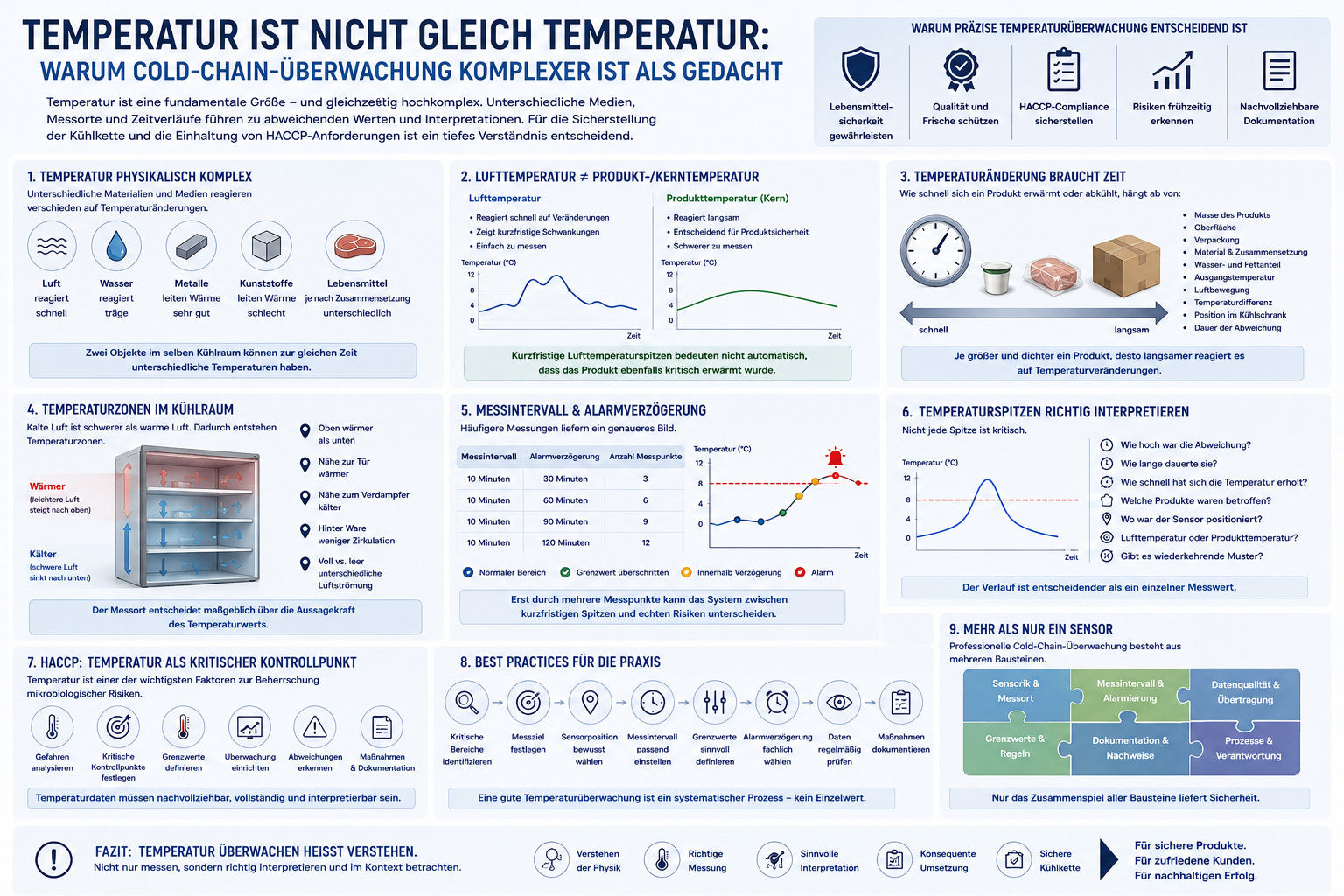
Temperature is not just temperature: Why cold chain monitoring is more complex than you think
At first glance, temperature seems simple. We see it daily on our smartphones, thermometers, in cars, on refrigerators, or in weather apps. A number, a unit, a value: 4 °C, -18 °C, or 22 °C.
However, in practice, temperature is significantly more complex.
Especially in the cold chain, i.e., in the storage, transport, and monitoring of temperature-sensitive products, it is not enough to simply record any temperature value. What matters is what exactly is measured, where it is measured, how quickly the temperature changes, and how the measured value needs to be interpreted.
Because air temperature is not automatically product temperature. A brief temperature spike does not necessarily mean that a food product is already at risk. And a seemingly stable measured value can still be problematic if the sensor is in the wrong place.
Temperature measurement is therefore not just metrology. It is interpretation.
Why temperature is physically complex
Simply put, temperature describes the thermal state of a body or medium. It is related to how much molecules move. The higher the temperature, the greater the thermal motion.
In practice, however, different media behave very differently:
- Air heats up and cools down quickly
- Water reacts much more slowly
- Metal conducts heat very well
- Plastic conducts heat less well
- Food products have different thermal properties depending on their composition
- Frozen products react differently than chilled products
- Packaging delays heat exchange
- measure directly in a product
- use a product simulation
- place a probe in a reference medium
- or interpret the air temperature in a technically correct way
- product mass
- product surface
- packaging
- material and composition
- water and fat content
- initial temperature
- air movement
- temperature difference to the environment
- position in the cooling unit
- duration of temperature deviation
- 30 minutes alarm delay = 3 measuring points at 10-minute intervals
- 60 minutes alarm delay = 6 measuring points
- 90 minutes alarm delay = 9 measuring points
- 120 minutes alarm delay = 12 measuring points
- top and bottom
- front and back
- proximity to the door
- proximity to the evaporator
- areas with good air circulation
- areas behind densely packed goods
- empty and fully loaded cooling units
- Should a technical fault be detected early?
- Should a critical storage area be monitored?
- Should the product temperature be approximated as realistically as possible?
- Should the air temperature in the cold room be documented?
- Should a HACCP-relevant control point be monitored?
- door opening
- storage of goods
- cleaning
- defrosting
- rearrangement
- draft
- loading with warm goods
- How high was the deviation?
- How long did it last?
- How quickly did the temperature recover?
- Which products were affected?
- Where was the sensor positioned?
- Was it air temperature or product temperature?
- Are there recurring patterns?
- short delay for sensitive products
- medium delay for normal cooling units
- longer delay for sluggish systems or larger cold rooms
- special evaluation for deep freezing, defrost cycles, or transport
- Temperature limits must be defined
- Measuring points must be sensibly chosen
- Measuring intervals must match the risk
- Deviations must be recognized
- Measures must be documented
- Evidence must be verifiable
- suitable sensors
- correct sensor positioning
- appropriate measurement intervals
- stable wireless transmission
- defined limit values
- sensible alarm delays
- traceable documentation
- regular data checks
- clear responsibilities
- corrective measures for deviations
- When did the deviation begin?
- How long did it last?
- How severe was it?
- Did the temperature recover quickly?
- Does the problem occur regularly?
- Are there differences between devices or locations?
- Are limit values and alarm delays set appropriately?
This means that two objects in the same refrigerator can have different temperatures at the same time.
A sensor therefore always measures only the temperature at its specific measuring point. It does not automatically measure the temperature of all products in the room.
Air temperature is not the same as product temperature
In many cooling units, the air temperature is measured. This is useful because it reacts quickly to changes and can reveal technical faults early on.
But air temperature and product temperature are not identical.
An example:
A refrigerator door is opened for a short time. Warm room air flows in. The sensor immediately measures a temperature rise. The air temperature may rise significantly within a few minutes.
However, the products in the refrigerator warm up much more slowly. A yogurt cup, a piece of meat, or a frozen product has a thermal mass. This mass ensures that the core temperature reacts much more slowly than the air temperature.
This is a crucial point for interpreting temperature data.
A brief air temperature spike can be uncritical. A prolonged increase, on the other hand, is significantly more relevant, because then the product temperature can also slowly rise.
Core temperature: The decisive, but difficult to measure value
From the perspective of product safety, the core temperature is often decisive. That is, the temperature inside a food product or other product.
This core temperature determines how much microorganisms can multiply, whether a product remains sufficiently chilled, or whether a frozen product begins to thaw.
The problem: The core temperature cannot always be easily and continuously measured during operation.
To do this, one would either have to:
In practice, air temperature is therefore often monitored because it is technically simpler, more hygienic, and can be automated permanently. For HACCP and cold chain monitoring, it is then crucial not to consider the air temperature in isolation, but in connection with the measuring location, time course, product type, and process.
Temperature change takes time
Another important factor is the speed of temperature change.
Air reacts quickly. A massive product reacts slowly.
How quickly a product heats up or cools down depends, among other things, on:
A small, unpackaged product reacts faster than a large, packaged carton. A single cup reacts faster than a densely packed pallet. A sensor in free air reacts faster than a sensor in a product simulation.
Therefore, in the cold chain, not only the temperature value is important, but also the time.
A temperature of +10 °C for two minutes is to be evaluated differently than +10 °C for two hours.
Why measuring intervals are so important
Temperature is a dynamic process. It changes constantly.
If a system measures only rarely, an incomplete picture emerges. A lot can happen between two measurement points: door openings, defrost cycles, technical faults, or short-term temperature spikes.
Therefore, measuring intervals are a central component of professional temperature monitoring.
With a 10-minute measuring interval, a significantly more accurate temperature profile is created than with a few measurements per day. This is particularly important when alarm delays are used.
Example:
Only through multiple measuring points can a system recognize whether it is a short, uncritical temperature spike or a persistent deviation.
Precisely for this reason, data quality is crucial. A long battery life alone says little if measurements are taken too infrequently.
Temperature zones in the refrigerator and cold room
Another point is often underestimated: The temperature is not the same everywhere in a cooling unit.
Cold air is denser and sinks. Warm air is lighter and rises. In addition, evaporators, fans, door openings, loading, and air circulation influence the temperature distribution.
This creates temperature zones.
Typical differences can occur between:
A sensor directly at the air outlet may measure different values than a sensor near the door. A sensor behind a box reacts differently than a freely placed sensor in the airflow.
Therefore, the measuring location is crucial.
A temperature monitoring system is only as good as the positioning of its sensors.
Why the measuring location determines the validity of the statement
A sensor should not be placed arbitrarily.
If it is installed in an unsuitable location, the data can be misleading.
Examples:
Sensor directly at the evaporator
The sensor measures very cold air and may show better values than in the rest of the cold room.
Sensor directly at the door
The sensor reacts strongly to every door opening and generates many temperature spikes.
Sensor behind goods
Air circulation is restricted. The sensor reacts more slowly and may detect changes later.
Sensor at the top of the refrigerator
It can be warmer there than in the lower area.
Sensor at the bottom of the refrigerator
It can be colder there, but not necessarily representative of all products.
The correct sensor position therefore depends on the goal:
These questions must be answered before installation.
Correctly interpreting temperature spikes
In practice, temperature spikes often arise from normal processes.
For example:
Not every spike is automatically critical. What is crucial is:
A single measured value says little. The trend is crucial.
Therefore, temperature monitoring should not only show limit values, but also document temperature trends and make them interpretable.
Why alarm delays are technically sensible
An immediate alarm for every exceedance of a limit value sounds safe at first. In practice, however, it can lead to many false alarms.
If an alarm is triggered every time a door is briefly opened, alarm fatigue sets in. Employees eventually take messages less seriously.
A sensibly set alarm delay helps to distinguish between short-term air temperature spikes and genuine risks.
The delay must match the process.
Examples:
Important: Alarm delay should not serve to hide problems. It must be technically justified.
HACCP: Temperature as a critical control point
The HACCP system is about identifying, evaluating, and controlling hazards. Temperature is one of the most important factors, as it has a direct influence on microbiological risks.
The HACCP principles require that relevant hazards are analyzed, critical control points are defined, limits are set, monitoring procedures are established, and deviations are documented. The FDA describes HACCP as a management system designed to control biological, chemical, and physical hazards through analysis and control.
For the cold chain, this means:
The challenge lies not only in measuring, but in correctly evaluating the measured values.
Cold Chain Monitoring is more than just a sensor
A single sensor does not make a secure cold chain.
Professional cold chain monitoring consists of several building blocks:
In professional practice, cold chain monitoring is understood as continuous monitoring along the supply chain to ensure the quality, safety, and traceability of temperature-sensitive products. Modern systems can help detect deviations earlier and provide data for audits.
How should this be handled in practice?
For businesses, this means: Temperature data should not be collected blindly. They must be meaningfully integrated into the process.
1. Identify critical areas
Which refrigeration units, cold rooms, or transport sections are truly relevant?
2. Define the measurement objective
Should air temperature, product temperature, or a critical area be monitored?
3. Deliberately choose sensor position
The sensor should be placed where the measured value is professionally meaningful.
4. Adjust measurement interval appropriately
For alarming, close-meshed measurements are more important than for pure documentation.
5. Define limit values
Limit values must match the product, process, and HACCP concept.
6. Choose alarm delay wisely
Not every short peak is critical. However, permanent deviations must be reliably detected.
7. Check data regularly
Temperature profiles often show patterns: door openings, defrost cycles, technical weaknesses, or incorrect loading.
8. Document measures
In case of deviations, it must be traceable what happened and how it was reacted to.
Why digital systems have an advantage here
Manual temperature controls usually only capture individual points in time. They do not show what happened between two checks.
Digital systems, on the other hand, can visualize temperature profiles.
This helps with questions such as:
This turns temperature monitoring from a simple mandatory task into a real quality tool.
Conclusion
Temperature seems simple, but in practice, it is highly complex.
A single temperature value provides only limited information. Crucial factors are the measuring location, medium, time course, product type, air movement, thermal mass, sensor position, and interpretation.
For the cold chain and HACCP, this means that temperature monitoring must not consist merely of reading a number. It must be understood as a system.
Good temperature monitoring does not just answer the question:
How warm or cold is it right now?
But also:
What does this value mean for the product, the process, and safety?
This is precisely the difference between simple temperature measurement and professional cold chain monitoring.
Share:
Regulation (EC) No 852/2004: The legal basis for HACCP
Why manual temperature logs become a risk in HACCP audits