

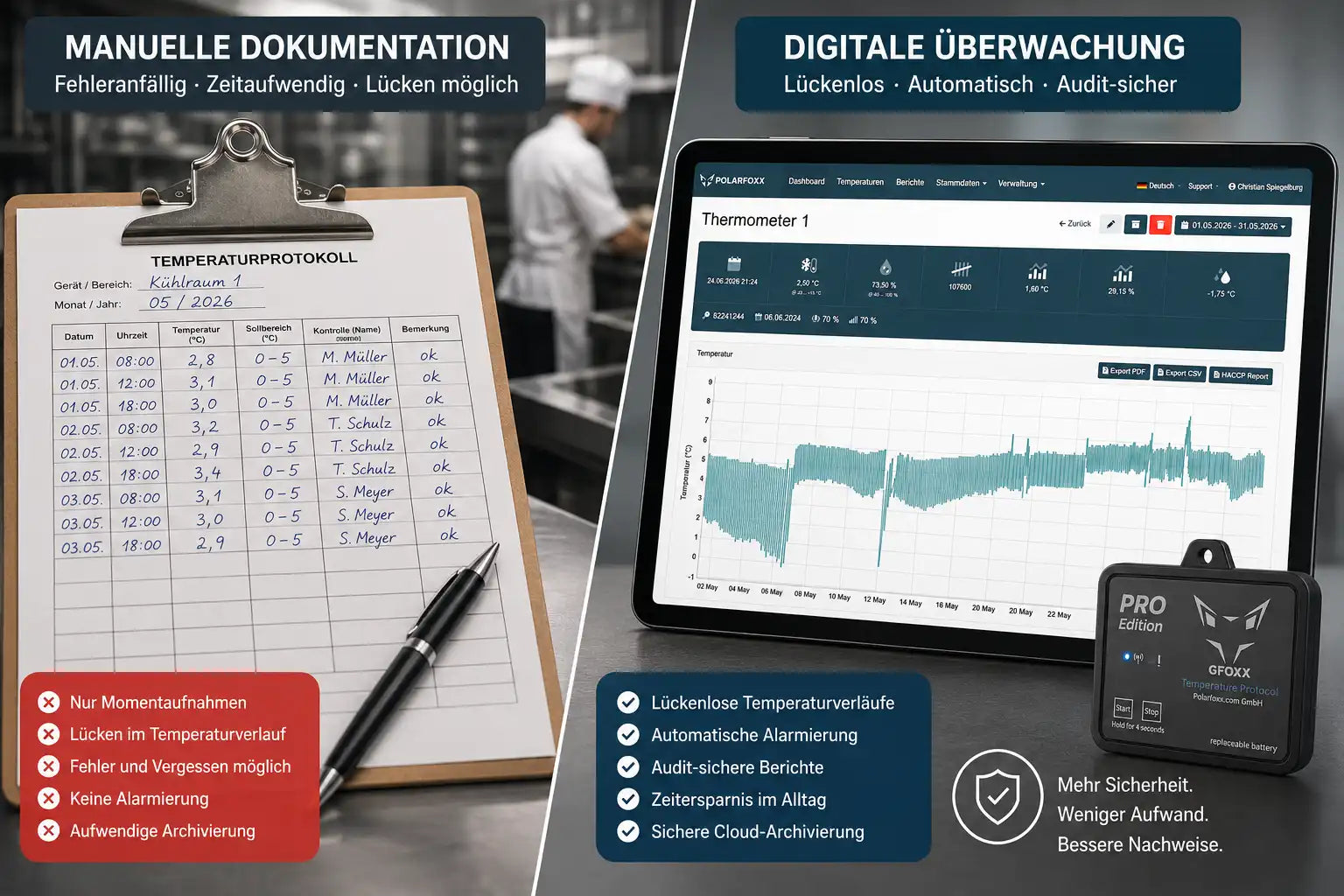
In many kitchens, bakeries, butcher shops, canteens, and food businesses, handwritten temperature logs are still part of daily routine.
Employees check refrigeration units, note down measurements on paper, and file the lists for potential audits or regulatory inspections.
At first glance, this approach seems sufficient.
In practice, however, weaknesses repeatedly emerge that can become problematic during audits, complaints, or damage incidents at the latest.
The challenge with manual checks
A manual temperature check always represents only a snapshot.
For example, temperatures are documented:
- at 8:00 AM
- at 12:00 PM (noon)
- at 6:00 PM
Between these times, there are several hours during which no one knows what actually happened.
Numerous events can occur during this period:
- power outages
- defective refrigeration units
- open doors
- technical malfunctions
- accidentally switched off devices
If the temperature is back within the target range at the time of the check, the incident often goes unnoticed.
Documented does not automatically mean proven
A common misconception is that a completed temperature log automatically serves as proof.
In fact, the list only documents that a value was recorded at a specific time.
What is not documented includes:
- the temperature profile
- the duration of possible deviations
- intermediate disturbances
- alarm events
- response times
Precisely within the framework of an HACCP concept, this information is becoming increasingly important.
Typical errors in paper logs
During audits, similar problems repeatedly occur:
Retrospective entries
Measured values are collected and entered later.
Missing measurements
Checks are forgotten or not carried out.
Illegible documentation
Handwritten records are difficult to decipher.
Transcription errors
Numbers are incorrectly noted or swapped.
No actions documented
A temperature deviation was detected, but the reaction to it was not recorded.
These errors do not necessarily arise intentionally. In the hectic everyday work, time pressure or staff shortages are enough.
What auditors increasingly expect
The requirements for traceability and documentation are continuously increasing.
Particularly important today are:
- seamless proof
- complete documentation
- traceable processes
- quick availability of data
- proof of corrective actions
Digital solutions can help provide information in a structured and auditable manner.
Temperature profiles instead of individual values
A key advantage of digital temperature monitoring lies in continuous recording.
Instead of three measurements per day, for example, the following are generated:
- 144 measurements per day at 10-minute intervals
- automatic storage
- histories
- alarm messages
- evaluations
This reveals:
- when a deviation occurred
- how long it lasted
- whether limit values were exceeded
- what measures were necessary
The quality of the documentation thus increases significantly.
Time savings in daily operations
In addition to greater transparency, another advantage is often underestimated:
Time.
Employees no longer have to:
- search for lists
- transfer values
- archive paper folders
- manually create reports
This leaves more time for the actual tasks in the company.
Digital documentation does not replace responsibility
However, it is important to note:
Even the best technology does not replace a functioning HACCP system.
Responsibilities, training, and regular checks remain indispensable.
Digital systems support processes – they do not replace them.
Conclusion
Manual temperature logs still serve their purpose in many businesses.
However, with increasing demands for documentation, traceability, and audits, paper lists are increasingly reaching their limits.
Continuous temperature monitoring creates more transparency, reduces sources of error, and allows for significantly better traceability of temperature events.
Because for food safety, what was once measured is often not the deciding factor.
What happened between the measurements is crucial.
Share:
Cold Chain Monitoring: Why Temperature Measurement Is More Than Just a Value
Heatwave: When cooling systems reach their limits