

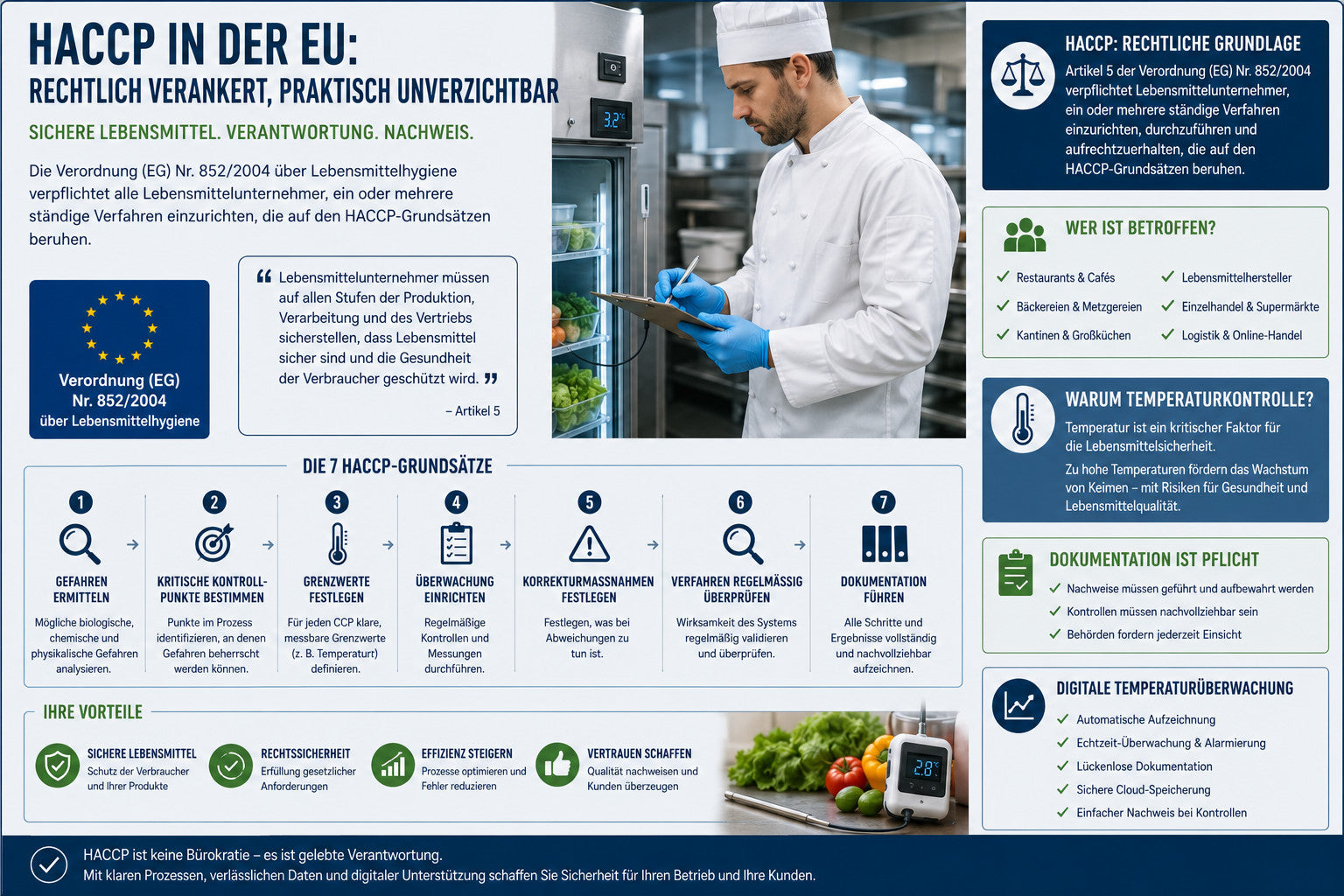
HACCP in the EU: Why Temperature Control is Legally Mandated
Food safety is not a voluntary quality standard but a central obligation for businesses that produce, process, store, transport, or place food on the market. In the European Union, Regulation (EC) No 852/2004 on the hygiene of foodstuffs forms one of the most important legal bases for these requirements.
It obliges food business operators to implement appropriate hygiene measures and establish procedures based on HACCP principles. Thus, HACCP is not just a theoretical concept, but a practical tool for risk minimization in the daily operations of catering, food retail, mass catering, production, and logistics.
What does Regulation (EC) No 852/2004 regulate?
Regulation (EC) No 852/2004 lays down general hygiene rules for food business operators. It applies to all stages of production, processing, and distribution of food, including, among others, the manufacture, storage, transport, sale, and supply of foodstuffs.
The aim is to ensure a high level of food safety. Food should be handled in such a way that health risks for consumers are avoided or controlled.
The regulation therefore affects not only large food producers but also smaller businesses such as:
- Restaurants
- Cafés
- Bakeries
- Butcher shops
- Ice cream parlors
- Hotels
- Canteens
- Caterers
- Supermarkets
- Delivery services
- Online food retailers
Even businesses that offer food online must register with the competent authority according to Article 6 of the regulation.
Article 5: The Basis for HACCP Procedures
Article 5 of the regulation is particularly important. It stipulates that food business operators must establish, implement, and maintain one or more permanent procedures based on the HACCP principles.
HACCP stands for:
Hazard Analysis and Critical Control Points
This means that a business must identify and evaluate potential hazards and establish appropriate measures to prevent, eliminate, or reduce these hazards to an acceptable level.
The Seven HACCP Principles
The regulation describes the HACCP principles as a structured approach to food safety. In practice, they can be divided into seven steps:
- Identify hazards
- Determine critical control points
- Establish critical limits
- Establish monitoring procedures
- Establish corrective actions
- Review procedures regularly
- Maintain documentation and records
These principles help businesses to systematically control risks, rather than just identifying them by chance.
Why temperature control is a central component of HACCP
Many foodborne risks are directly related to temperature. Bacteria and other microorganisms can multiply faster at unsuitable temperatures. Cooling slows down this growth, while heat can kill many germs.
Therefore, temperature control is a crucial component in many HACCP concepts.
Typical temperature-critical areas include:
- Goods inward
- Refrigerated rooms
- Freezer storage
- Refrigerators
- Refrigerated display cases
- Transport
- Intermediate storage
- Food serving
- Regeneration and hot holding
The regulation also requires that suitable devices or facilities for maintaining and monitoring appropriate temperature conditions must be available, if necessary.
HACCP means not just controlling, but proving
A common mistake in practice is the assumption that occasional temperature checks are sufficient. However, for a functional HACCP system, it is crucial that controls are documented in a verifiable manner.
Because during an audit or internal review, the question is not just:
Was the temperature maintained?
But also:
Can the business prove that the temperature was maintained?
Documentation is therefore an essential part of the HACCP system. According to Article 5, paragraph 4 of the regulation, food business operators must be able to provide proof to the competent authority and keep documents up to date.
Paper lists or digital documentation?
Many businesses still use paper lists. While these can fundamentally work, they have typical weaknesses:
- Entries are forgotten
- Values are backdated
- Handwriting is difficult to read
- Lists get lost
- Evaluation is time-consuming
- Deviations are detected late
- Evidence is not centrally available
Digital temperature documentation can reduce these weaknesses. Sensors, data loggers, and cloud systems automatically record temperature values and store them verifiably.
This supports businesses in implementing their HACCP obligations more efficiently.
Digital systems do not replace responsibility
It's important to note: A digital system does not absolve the food business operator of responsibility. The business remains responsible for its processes, critical limits, corrective actions, and organizational procedures.
However, digital temperature monitoring can help to better fulfill this responsibility.
It supports with:
- automatic recording
- seamless documentation
- quick detection of deviations
- alarming at critical temperatures
- central evaluation
- preparation for inspections
- reduction of manual errors
- proof to authorities or customers
Thus, technology becomes a tool to implement HACCP more easily, securely, and transparently in everyday operations.
HACCP is risk-based
Not every business needs the same system. A small cafe has different requirements than a cold storage facility, a large kitchen, a hospital, or a food producer.
The regulation considers that the type and size of the food business play a role. Authorities also evaluate evidence and documentation in relation to the respective business.
This means: HACCP must fit the practice. It should neither be over-engineered nor superficial.
The crucial thing is that relevant risks are identified, controlled, and documented.
Why this topic is particularly important for small and medium-sized businesses
Smaller businesses, in particular, often underestimate the effort involved in temperature documentation. In daily operations, manual checks initially seem simple: read the thermometer, record the value, file the list.
However, over weeks, months, and years, this results in a considerable organizational effort.
Digital solutions can particularly help where:
- several cooling devices are monitored
- personnel frequently changes
- checks are forgotten
- audits need to be prepared
- documentation needs to be centrally available
- temperature deviations need to be detected early
For small businesses, a simple Bluetooth data logger can already be a meaningful entry-level solution. For larger or more critical applications, LoRa, WLAN, or 4G-based systems with cloud connectivity and alerting can be useful.
Conclusion
Regulation (EC) No 852/2004 forms a central legal basis for food hygiene and HACCP in the European Union. It obliges food business operators to establish, implement, and maintain procedures based on HACCP principles.
Temperature control is an essential component of many HACCP concepts. Especially for chilled, frozen, or perishable foods, the correct temperature is crucial for safety, quality, and shelf life.
Anyone who only controls temperatures but does not document them verifiably creates a gap in evidence in an emergency.
Digital temperature documentation helps to close this gap. It does not make HACCP more complicated, but rather simpler, more transparent, and more reliable in everyday operations.
Because food safety doesn't start with regulatory inspections. It starts in daily operations – with clear processes, reliable data, and thorough documentation.
Share:
Temperature documentation: Why manual lists are often more expensive than you think
Cold Chain Monitoring: Why Temperature Measurement Is More Than Just a Value