

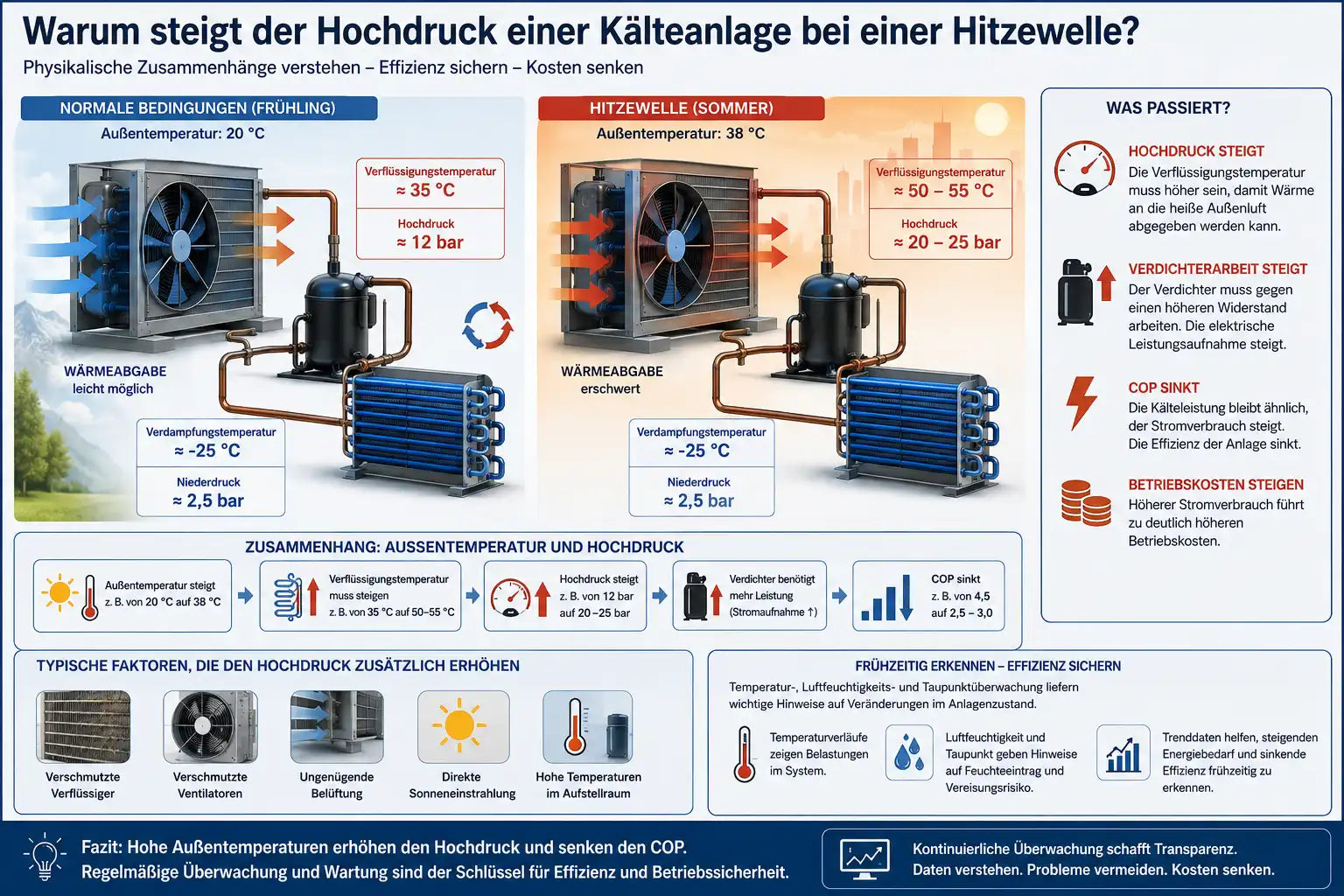
Why does a refrigeration system's high pressure increase during a heatwave?
High outdoor temperatures do not automatically mean a problem – but they do increase the demands on every refrigeration system.
During a heatwave, many operators report rising electricity costs, longer compressor runtimes, and high-pressure faults. Quickly, the impression arises that the refrigeration system "no longer has enough capacity."
In reality, it often works exactly as it was designed.
The actual problem lies in the physical boundary conditions.
How does the condenser work?
After the compressor has compressed the gaseous refrigerant, it has:
- high pressure,
- high temperature,
- and high energy content.
This heat must then be released to the environment via the condenser.
Only then can the refrigerant be liquefied again, and the actual refrigeration process starts anew.
The condenser therefore works like a heat exchanger between the refrigerant and the ambient air.
Why does it get more difficult in summer?
Heat always flows from the warmer medium to the colder medium.
The greater this temperature difference, the easier the heat transfer works.
Example:
- Outdoor temperature in spring: 20 °C
- Condensing temperature: 35 °C
Temperature difference:
15 Kelvin
On a hot summer day:
- Outdoor temperature: 38 °C
For the condenser to continue to dissipate enough heat, the refrigerant must become significantly hotter.
For example, the condensing temperature rises to:
50 to 55 °C
This inevitably also increases the high pressure in the refrigeration circuit.
Why does the compressor now need more energy?
As the high pressure increases, the compressor has to compress the refrigerant against higher resistance.
This means:
- higher compression work,
- higher current consumption,
- longer runtimes,
- higher component temperatures.
The refrigeration system thus continues to generate the same cooling capacity – but requires significantly more electrical energy to do so.
What does this mean for the COP?
The COP (Coefficient of Performance) describes the ratio between the cooling capacity generated and the electrical power input.
The higher the high pressure becomes, the worse this efficiency becomes.
The consequences:
- rising operating costs,
- decreasing energy efficiency,
- higher compressor load,
- lower power reserves.
Which factors additionally exacerbate the problem?
In addition to the outdoor temperature, other factors influence the high pressure:
- contaminated condensers,
- blocked air paths,
- dirty fans,
- direct sunlight,
- insufficient ventilation,
- high ambient temperatures in technical rooms.
Often, several of these factors act simultaneously.
How to recognize increasing energy demand?
Not every system has permanent high-pressure measurement.
Nevertheless, changes can often be detected indirectly.
Typical indicators are:
- longer compressor runtimes,
- more frequent start-stop cycles,
- increasing power consumption,
- longer cooling times after door openings,
- increased evaporator icing due to longer runtimes.
Temperature alone does not tell the whole story
A refrigeration system can continue to reliably maintain its target temperature and still operate significantly less efficiently.
Therefore, it is worthwhile to consider other measured variables.
In addition to temperature, these include:
- humidity,
- dew point,
- temperature profiles,
- alarm histories
- and runtime developments
provide valuable insights into changes in the system status.
Intelligent monitoring instead of pure limit values
Modern monitoring systems today no longer exclusively record temperature values.
By combining temperature, relative humidity, and automatically calculated dew point, thermodynamic relationships can be assessed much better.
LoRaFOXX temperature and humidity sensors continuously record these measured variables. The PolarFOXX Cloud then uses this data to calculate the dew point, among other things. This allows operators to detect changes that indicate increasing moisture ingress, increasing icing, or decreasing system efficiency – often long before limit values are exceeded.
In the long term, precisely such measured variables form the basis for intelligent condition indicators, with which changes in system behavior can be detected early and maintenance measures can be planned in a targeted manner.
Conclusion
High outdoor temperatures do not automatically increase the cooling capacity a system must generate – but they make heat dissipation via the condenser more difficult.
This increases the high pressure, the compressor requires more energy, and the COP decreases.
Anyone who wants to evaluate the condition of a refrigeration system in the long term should therefore not only pay attention to the temperature. Only the interplay of various measured variables allows a sound assessment of energy efficiency and system condition.
Share:
The cooling system isn't the problem – it's the building
The Physics of Refrigeration