

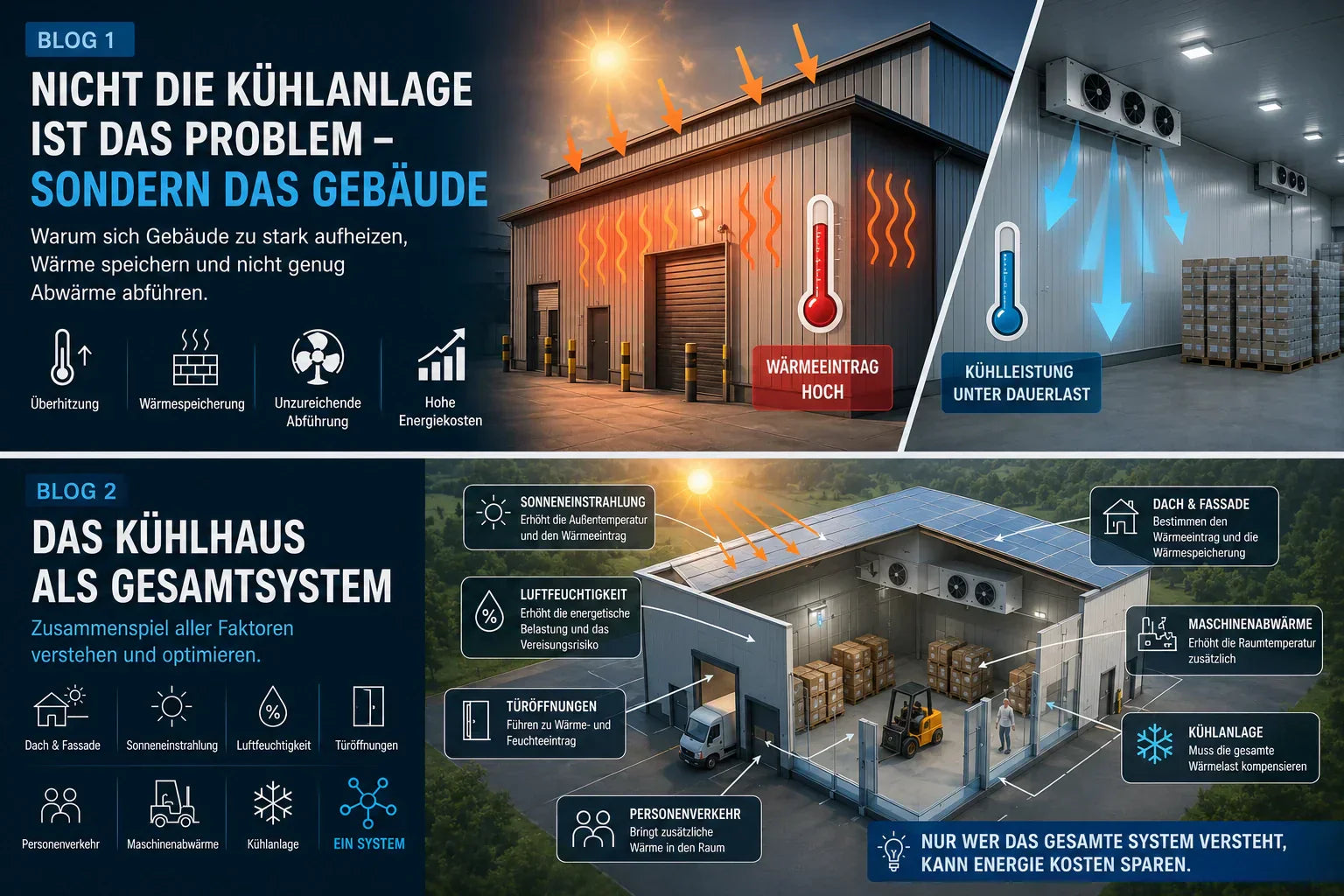
The refrigeration system isn't the problem – the building is
Why many cold stores waste unnecessary energy
When the temperature in the cold room rises, the first assumption is almost always:
"The refrigeration system is too small."
However, in practice, a completely different picture is emerging more and more frequently.
The refrigeration system is working perfectly. Evaporators and condensers are clean. The refrigerant circuit is in order. Nevertheless, temperatures rise in summer, operating times lengthen, and electricity consumption explodes.
The real culprit is often not the refrigeration system – but the building.
A cold store is only as good as its surroundings
Many cold stores are installed in existing halls or production buildings. It is often forgotten that not only the cold store itself, but also the entire building envelope heats up.
On hot summer days, several problems arise simultaneously:
- Roof surfaces reach temperatures of over 70 °C.
- Walls store heat for many hours.
- The hall air heats up continuously.
- Machinery generates additional waste heat.
- Heat often cannot escape sufficiently at night.
The result:
The ambient temperature around the cold store continuously increases.
As a result, the refrigeration system no longer works against the outside temperature, but against a permanently heated thermal reservoir.
The invisible heat trap
Buildings act like giant batteries.
They store enormous amounts of heat during the day and release it again with a time delay.
This means:
Even if the outside temperature drops in the evening, the hall often remains warm for many hours.
The refrigeration system therefore has to operate almost at full capacity even at night.
Many operators wonder why their cooling system hardly switches off even at midnight.
The reason is often not in the refrigeration technology, but in the building physics.
More cooling capacity doesn't solve the actual problem
A larger refrigeration system initially seems like the logical solution.
In reality, however, it merely treats the symptoms.
The actual problem – the constant heat input into the building – remains.
The consequences:
- higher investment costs
- increasing energy consumption
- longer operating times
- higher wear and tear
- shorter system lifespan
This is comparable to an air conditioning system in a house whose windows are permanently open.
Buildings must be rethought in the future
With rising summer temperatures, it is no longer enough to look exclusively at the refrigeration system.
The entire building construction must become part of the planning process.
This includes, for example:
- high-quality roof and wall insulation
- light or reflective roof surfaces
- shading critical areas
- consistent separation of warm and cold zones
- targeted natural night ventilation
- active hall cooling
- controlled air circulation
- avoidance of unnecessary heat sources in the building
The goal is:
Not just to generate cold – but to reduce heat input.
Saving energy starts outside the cold room
Every degree less in ambient temperature reduces the load on the refrigeration system.
Significant energy savings can often be achieved with structural optimizations.
Those who invest exclusively in larger refrigeration units often forgo savings potential elsewhere.
The most economical kilowatt-hour is the one that is not needed at all.
Measure instead of assume
Many companies don't even know how much their building heats up during the day.
Only through continuous temperature measurements at various points does it become visible
- when the hall absorbs heat,
- how long it stores this heat,
- which areas are particularly critical, and
- how weather, solar radiation, and operating times affect cooling.
Exactly these data form the basis for sound decisions.
Because only those who know the actual heat input can take targeted measures.
Conclusion
The future of energy-efficient cold stores is not decided solely by the refrigeration system.
It begins with the building construction.
Those who prevent heat from arising or entering reduce energy costs, relieve the refrigeration system, and simultaneously increase its lifespan.
The necessary rethinking is therefore:
Not to generate more cold – but to let less heat into the building.
Especially against the backdrop of rising energy costs and increasingly hot summers, this holistic view of buildings and refrigeration technology will become a decisive competitive advantage in the future.
Share:
Cooling system vs. Building construction – Where do the actual energy costs arise?
The Physics of Refrigeration