

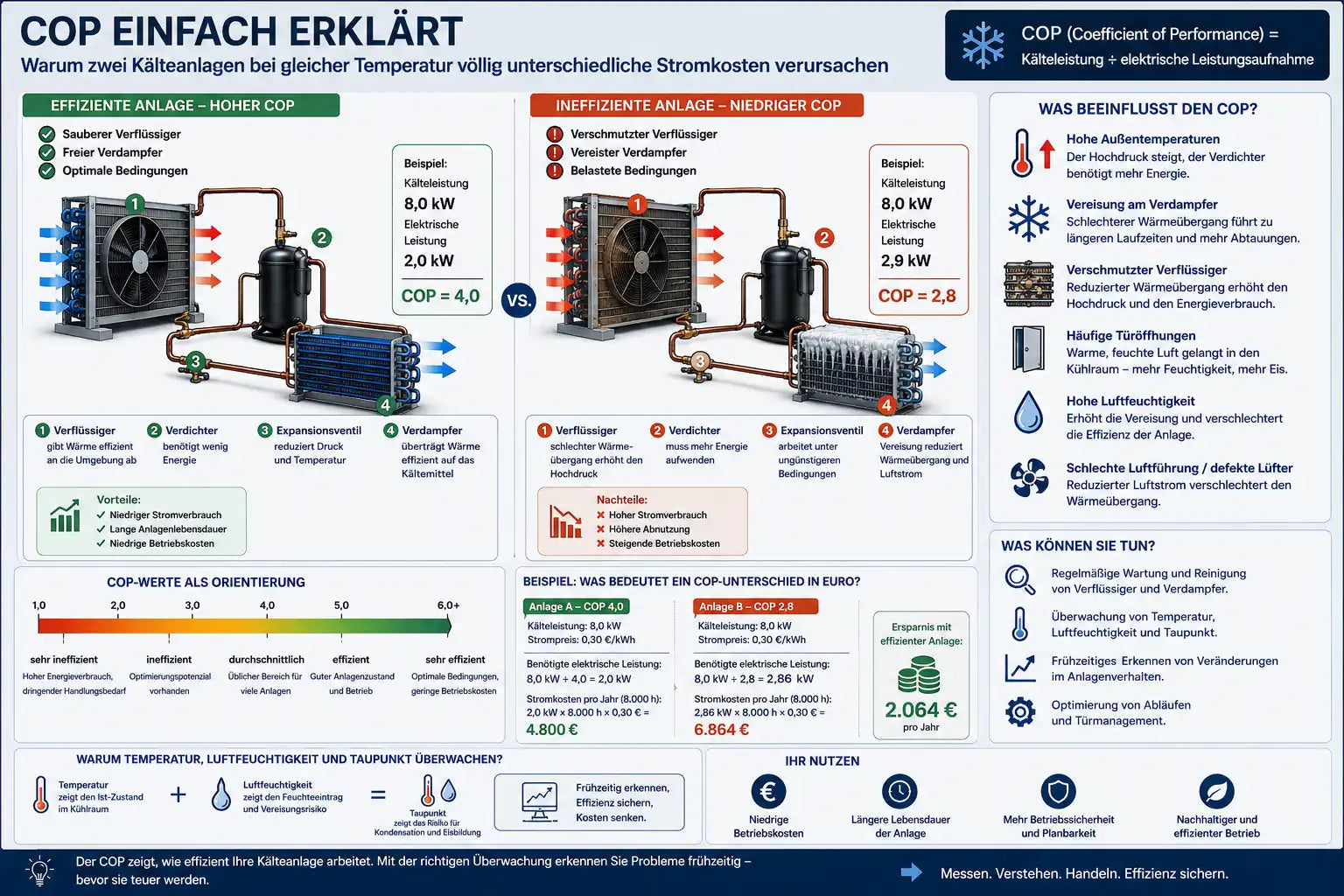
COP simply explained – Why two refrigeration systems cause completely different electricity costs at the same temperature
The temperature is identical – the electricity bill is not.
Two freezer systems reliably maintain -20 °C.
Both fulfill their task.
Nevertheless, one system may consume 20 to 40% more energy over the year than the other.
How can this be?
The answer lies in the COP (Coefficient of Performance) – one of the most important key figures in refrigeration technology.
It describes how efficiently a refrigeration system operates and how much cooling capacity it can generate from one kilowatt-hour of electrical energy.
What does COP mean?
The COP is the ratio between the generated cooling capacity and the consumed electrical power.
Simply put:
COP = Cooling capacity ÷ Electrical power consumption
An example:
A refrigeration system requires 2 kW of electrical power and generates 8 kW of cooling capacity.
The COP is:
COP = 8 ÷ 2 = 4
This means:
Four kilowatt-hours of cooling capacity are generated from one kilowatt-hour of electricity.
The higher this value, the more economically the system operates.
Why does the COP decrease?
Many operators believe that a refrigeration system always operates with the same efficiency.
In fact, the COP constantly changes.
Even small changes in operating conditions affect efficiency.
For example:
- rising outdoor temperatures,
- dirty condensers,
- iced evaporators,
- frequent door openings,
- high humidity,
- poor air circulation,
- defective fans.
All these factors increase energy consumption.
Why does the condenser play such a big role?
The condenser releases the absorbed heat to the environment.
The hotter the outside air, the more difficult this heat transfer becomes.
The high pressure increases.
The compressor has to work harder.
Electrical power consumption increases.
The actual cooling capacity, on the other hand, remains almost unchanged.
This automatically lowers the COP.
The evaporator also affects efficiency
It's not just the condenser that determines efficiency.
An iced evaporator also significantly impairs heat transfer.
The consequences:
- longer compressor runtimes,
- more frequent defrost cycles,
- increasing power consumption,
- decreasing COP.
Especially in summer, high humidity further amplifies this effect.
Small causes – big effects
In practice, several influences often accumulate simultaneously.
A dirty condenser, a slightly iced evaporator, and frequent door openings collectively lead to the compressor running significantly longer.
The temperature may remain constant.
The operator initially only notices increasing energy costs.
Why temperature alone does not allow a statement about efficiency
A system can reliably maintain the set temperature at all times and still operate uneconomically.
Temperature merely shows the result.
It says nothing about
- how much energy was required for it,
- how heavily the compressor is loaded,
- or whether efficiency is gradually deteriorating.
Therefore, mere temperature monitoring is not sufficient in the long run.
More readings mean more insights
Those who additionally monitor
- temperature,
- relative humidity,
- dew point
- and their temporal development
often detect changes much earlier.
Rising humidity, for example, can indicate increased moisture ingress.
This increases evaporator icing.
Heat transfer deteriorates.
The compressor runs longer.
The COP decreases.
These correlations can be recognized before critical temperature deviations become noticeable.
For this reason, LoRaFOXX temperature and humidity sensors record not only temperature but also relative humidity. In the PolarFOXX Cloud, the dew point is automatically calculated from this.
This provides a significantly more comprehensive picture of the actual condition of a refrigeration system than temperature alone.
The next step: Condition-oriented monitoring
The future of modern refrigeration systems no longer lies exclusively in documenting temperatures.
The intelligent evaluation of the system's condition is becoming increasingly important.
By combining various measured variables, developments can be identified that indicate decreasing energy efficiency or increasing system load.
This is precisely where the foundations are laid for new key performance indicators that make the technical condition of a refrigeration system transparent and can alert operators to changes early on.
Conclusion
The COP is one of the most important key figures in refrigeration technology.
It determines how economically a refrigeration system operates and how much electricity is required for the same cooling capacity.
Rising outdoor temperatures, icing, dirty heat exchangers, or high humidity often gradually worsen the COP.
Those who monitor humidity and dew point in addition to temperature receive valuable additional information to detect changes early and improve energy efficiency in the long term.
Because not only the achieved temperature is crucial.
At least as important is the question of how efficiently it is achieved.
Share:
The Physics of Refrigeration
Last Mile, High Stakes: Why Temperature Control in Deliveries is Critical