

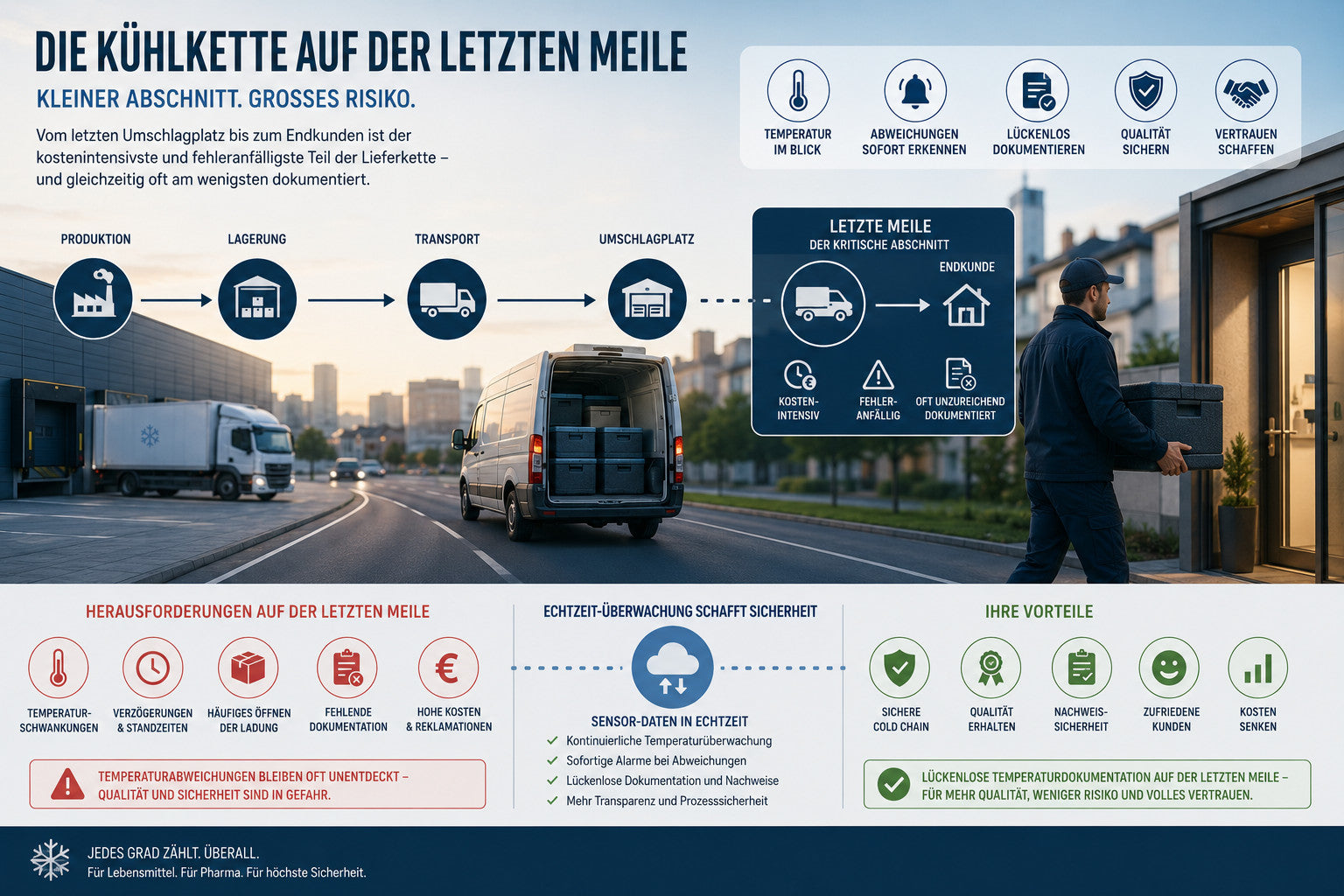
Last-Mile Cold Chain: The Critical Section Often Under-Documented
The cold chain does not end in the warehouse, not in the cold storage, and not when loading into a vehicle. Especially the last section of a delivery – from the last transshipment point to the end customer – is one of the most critical phases of the entire supply chain. This so-called last mile is particularly demanding. It is often costly, difficult to plan, and susceptible to temperature deviations. At the same time, precisely this section is still not sufficiently documented in many processes. For perishable foods, frozen goods, pharmaceutical products, or temperature-sensitive raw materials, this can pose a significant risk.

What does "last mile" mean in the cold chain?
The last mile refers to the final transport section of goods to the recipient. This can be, for example:
- the delivery from the regional transshipment point to the restaurant
- the delivery of frozen goods to a branch
- the transport of refrigerated food to the end customer
- the delivery of pharmaceuticals to pharmacies, practices, or care facilities
- the handover of temperature-sensitive products to a business
Especially in this section, many influencing factors come together: time pressure, fluctuating outside temperatures, frequent opening of doors, different packaging, multiple stops, and changing handover points.
Why the last mile is particularly prone to errors
While warehouses, cold storages, and central logistics areas are often well monitored, the last mile is significantly more dynamic.
Typical risks include:
- long downtimes during loading
- delays due to traffic or route planning
- frequent opening of vehicle doors
- insufficiently pre-conditioned packaging
- incorrect loading
- damaged insulated packaging
- unclear responsibilities during handover
- missing temperature data during transport
- missing documentation at the recipient
Especially with multiple stops, the risk can increase. Every door opening, every delay, and every incorrect intermediate storage can affect the temperature.
Why the last mile is so costly
The last mile is not only technically demanding, but also economically expensive.
Reasons for this include:
- high personnel costs
- individual delivery addresses
- short delivery windows
- many individual stops
- rising energy costs
- special refrigerated vehicles or thermal boxes
- inquiries and complaints
- redeliveries in case of quality problems
- documentation and proof obligations
The more sensitive the goods, the higher the requirements. Food, frozen products, or pharmaceuticals not only require appropriate packaging but also a traceable temperature profile.
Optimized packaging alone is not always enough
Modern insulated packaging, cold packs, dry ice, thermal boxes, or passive cooling systems can significantly improve temperature stability. They are an important component of a secure last mile.
However, packaging alone does not answer all questions:
- Was the temperature maintained throughout the entire delivery?
- Were there critical deviations?
- How long was the merchandise outside the permissible range?
- Was the packaging correctly pre-conditioned?
- Was the merchandise stored correctly immediately upon receipt?
- Can the temperature profile be proven in case of a complaint?
Without measurement data, often only an assumption remains. For quality management, HACCP, GDP-related processes, or internal audits, this is often not sufficient.
The Solution - Real-time sensors create transparency
Real-time sensors can help to better secure the last mile. They record temperature data during transport and, depending on the system, enable direct transmission to a cloud platform.
This provides important advantages:
- continuous temperature monitoring
- early detection of deviations
- better traceability in case of complaints
- transparent handover processes
- digital documentation instead of paper proof
- better evaluation of weak points
- optimization of packaging, tours, and processes
Real-time data is particularly valuable when critical deviations can be responded to immediately. Then temperature monitoring becomes not just documentation, but an active instrument of quality assurance.
The documentation gap on the last mile
In many companies, the cold chain in the warehouse is well documented. Cold rooms, freezers, and production areas are also increasingly digitally monitored.
The last mile, however, often remains a gap.
Often documented is:
- that goods have been shipped
- when it was delivered
- who accepted it
But not always documented is:
- what temperature prevailed during delivery
- whether there were any deviations along the way
- how long the goods were in a critical range
- whether the packaging fulfilled its protective function
- whether the goods were still within the permissible temperature range at handover
Especially for temperature-sensitive products, this gap is problematic. Because in the event of damage, the question is not only whether it was delivered, but whether the goods were correctly tempered during delivery.
Food and Pharma: Different Industries, Similar Risk
The requirements differ depending on the industry, but the basic problem is similar.
Food
With food, it's about freshness, quality, shelf life, and food safety. Particularly critical are:
- meat
- fish
- dairy products
- delicatessen
- frozen food
- convenience products
- chilled ready meals
- sensitive raw materials
Temperature deviations here can lead to loss of quality, reduced shelf life, or in the worst case, to hygiene risks.
Pharmaceuticals
In pharmaceuticals, temperature deviations can impair the efficacy or stability of a product. Particularly relevant are:
- refrigerated medicines
- vaccines
- diagnostics
- laboratory samples
- temperature-sensitive active ingredients
Traceable temperature documentation is particularly important here, as the requirements for quality assurance and proof are high.
Why handover is particularly critical
A frequently underestimated moment is the handover to the end customer or business.
Examples:
- goods left unchilled for too long before acceptance
- recipient is not immediately available
- delivery is placed in the wrong area
- refrigerated goods are only stored later
- responsibilities are not clearly regulated
- temperature is not checked at handover
Especially here, digital documentation can help. If temperature data is available until handover, it is easier to verify whether the goods were transported correctly.
Temperature control as part of quality assurance
A secure last mile consists of several components:
- suitable packaging
- correct pre-conditioning
- appropriate transport solution
- clear handover processes
- trained staff
- temperature monitoring
- digital documentation
- evaluation of deviations
Only the interplay of these factors creates a reliable cold chain.
Video: #GastronomieFoxx The Bluetooth thermometer is the "all-in-one" solution for HACCP documentation.
Why digital proofs are becoming increasingly important
Paper-based documentation quickly reaches its limits on the last mile. It is often incomplete, time-delayed, or difficult to verify.
Digital temperature data, however, offers clear advantages:
- automatic recording
- fewer manual errors
- better readability
- fast evaluation
- central storage
- easy proof during audits
- better comparability between tours
- transparent complaint processing
For companies, this means: Fewer discussions, better processes, and more security in handling temperature-sensitive goods.
Real-time data also helps with process optimization
Temperature monitoring is not just a control instrument. It can also help improve processes.
By evaluating temperature data, questions such as these can be answered:
- Which routes are particularly critical?
- Which packaging maintains the temperature best?
- Where do recurring temperature peaks occur?
- Which handover points cause problems?
- Which outside temperatures particularly strongly influence the delivery?
- How long does the merchandise actually remain in the secure area?
Such data helps to specifically optimize packaging, tour planning and handover processes.
The last mile is the most demanding section of the cold chain
The last mile is one of the most demanding sections of the cold chain. It is cost-intensive, dynamic, and particularly prone to errors. At the same time, it is not yet sufficiently documented in many companies.
For perishable food, frozen goods, and pharmaceutical products, it is not enough to only monitor warehouses and cold rooms. The entire temperature profile up to handover is crucial.
Optimized packaging is important. Real-time sensors and digital temperature documentation such as the GFOXX from PolarFOXX additionally create transparency, traceability, and security.
Because in the end, it's not just about whether a product has arrived.
What matters is whether it remained within the permissible temperature range throughout the entire last mile.
Share:
The Physics of Refrigeration
Gastronomy in Transition: Humans, Robots, and the Importance of the Cold Chain