

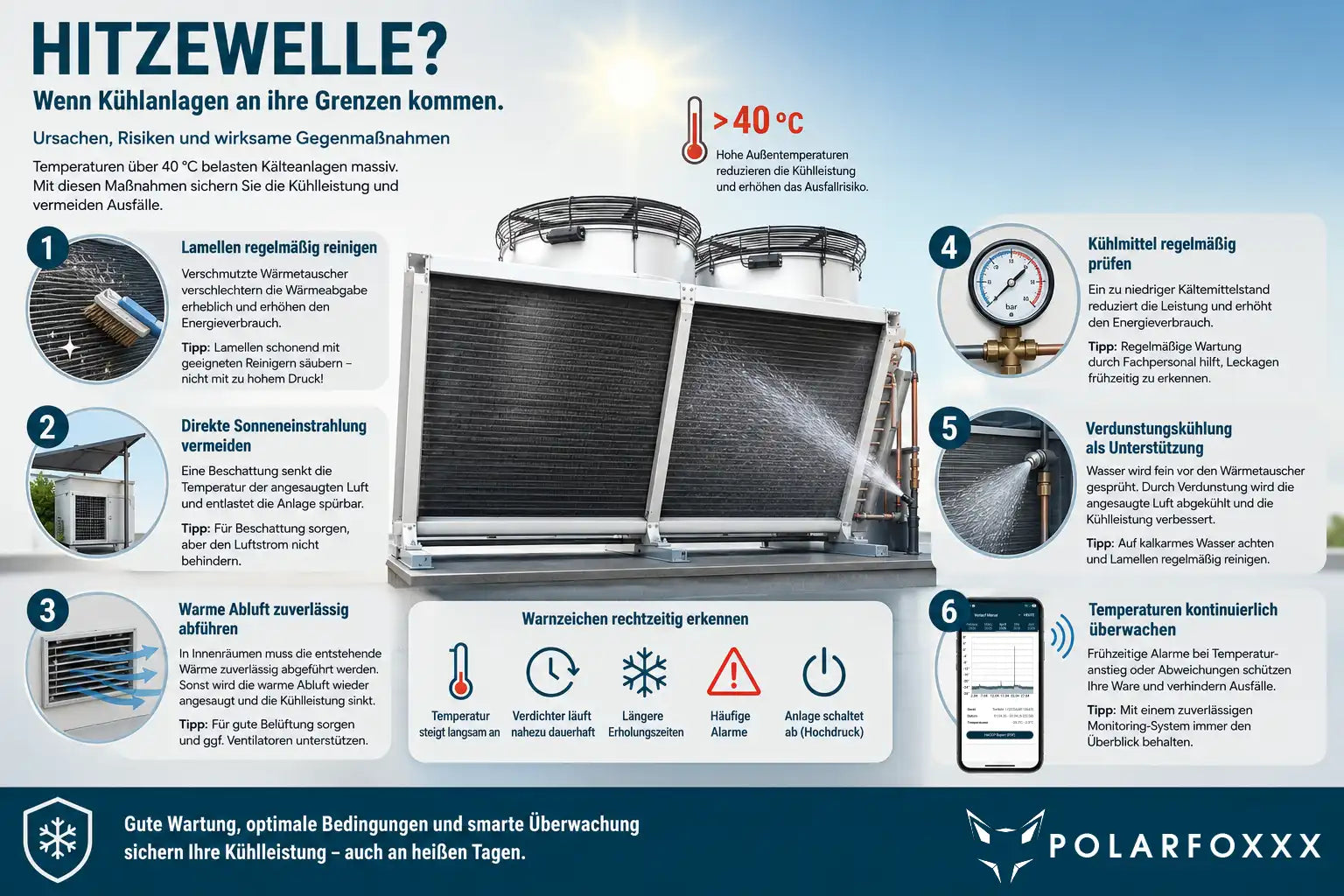
Temperatures above 40 °C – a challenge for every refrigeration system
The past few days have shown that extreme heatwaves are no longer an exception. Outdoor temperatures exceeding 40 °C place a significant strain not only on people but also on cooling and refrigeration systems. Especially in gastronomy, food production, pharmacies, laboratories, or retail, a decrease in cooling performance can quickly lead to considerable damage.
Many operators only notice the gradual decline in performance when the temperature in the cold room is already rising or the system even shuts down due to a high-pressure fault.
Why does cooling performance decrease in extreme heat?
A refrigeration system transfers heat from the cold room to the outside. The hotter the ambient air, the more difficult this heat exchange becomes.
The consequences:
- The compressor operates at a higher pressure.
- Energy consumption increases significantly.
- The available cooling capacity decreases.
- The system runs almost continuously at full load.
- In the worst case, a safety shutdown occurs due to excessive pressures or temperatures.
This becomes particularly critical for older or contaminated systems.
Typical warning signs
Even before a complete failure, there are often initial indications:
- The cooling temperature slowly rises.
- The compressor runs almost continuously.
- Cold rooms take significantly longer to cool down.
- Temperature alarms occur more frequently.
- The system occasionally shuts down due to high pressures or temperatures.
These measures help in extreme heat
1. Clean fins regularly
Contaminated heat exchangers significantly impair heat dissipation. Even dust, pollen, or grease deposits can significantly reduce efficiency.
Important: The sensitive fins must not be bent or cleaned with excessive water pressure. Suitable fin cleaners and soft brushes are the better choice here.
2. Ensure free airflow
Condensers require sufficient fresh air.
Make sure that:
- no objects block the air supply,
- sufficient distance from walls is maintained,
- plants or contaminants are removed.
3. Reliably remove warm exhaust air
If the refrigeration system is located in a technical room or indoors, the generated heat must be reliably dissipated.
Helpful measures include, for example:
- additional ventilation openings,
- more powerful exhaust systems,
- supporting fans for better air circulation.
Because if the warm exhaust air is repeatedly drawn in, the cooling performance decreases significantly.
4. Have refrigerant checked regularly
An insufficient refrigerant level reduces the system's performance and simultaneously increases energy consumption.
Regular maintenance helps to detect leaks early and ensure optimal function.
5. Avoid direct sunlight
If the condenser is constantly exposed to direct sunlight, the strain increases further.
Suitable shading can lower the temperature of the intake air. It is important not to obstruct the airflow.
6. Evaporative cooling as an emergency measure
In extreme outdoor temperatures, some operators rely on additional evaporative cooling.
Water is finely sprayed in front of the heat exchanger. The evaporation cools the intake air, which can improve cooling performance.
This measure can be useful in exceptional situations but should be implemented professionally. Hard water can cause limescale deposits, which is why regular cleaning of the fins is particularly important.
Temperature monitoring with LoRaFOXX provides security
Especially during heatwaves, continuous temperature monitoring is worthwhile.
If the temperature in the cold room gradually rises or the system operates continuously at full load, automatic alarms can indicate problems early – before food, medication, or other temperature-sensitive goods are damaged.
Conclusion
Extreme summers will occur more frequently in the future. It is all the more important to regularly maintain cooling systems, ensure optimal operating conditions, and continuously monitor critical temperatures.
With simple measures such as clean heat exchangers, good ventilation, adequate shading, and reliable temperature monitoring, the risk of failures can be significantly reduced – even on the hottest days of the year.
Share:
Why manual temperature logs become a risk in HACCP audits
Why a Heatwave Puts Multiple Stresses on Refrigeration Systems