

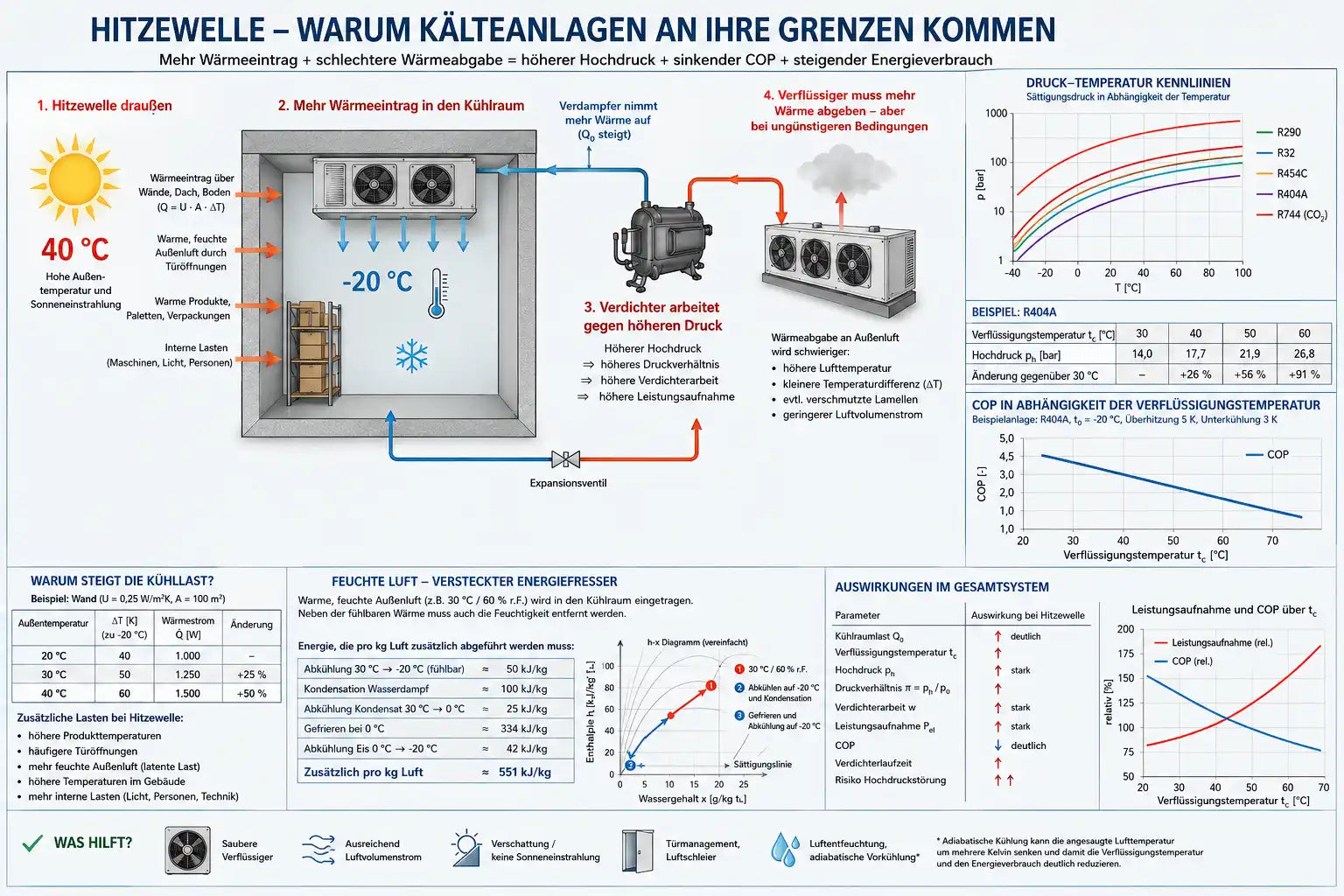
Initial Situation:
During the last heatwave with outside temperatures exceeding 40 °C, many operators of refrigeration and freezer systems struggled with rising temperatures, longer operating times, or even high-pressure faults. It is often assumed that the outside temperature alone is responsible for these problems. In reality, however, several thermodynamic effects work simultaneously – and it is precisely their combination that pushes many refrigeration systems to their performance limits.
Heat does not disappear – it must be transported
The task of a refrigeration system is not to generate cold. It transports heat from a low temperature level to a higher one.
The evaporator removes heat from the cold room. The compressor then increases the pressure and temperature of the refrigerant so that this heat can be released to the surroundings in the condenser.
The more heat that enters the cold room, the more energy the refrigeration system has to transport.
The air itself is not the actual problem
Many suspect that mainly the warm air needs to be cooled. In fact, however, air has a comparatively low heat capacity and mass.
The actual heat storage units are:
- Walls and ceilings
- Concrete floors
- Shelves and storage technology
- Machines and conveyor systems
- Packaging
- Pallets
- Goods brought in
- Solar radiation on the building
All these components continuously heat up during a heatwave and release their heat into the cold room.
The refrigeration system must permanently dissipate this additional energy.
As the outside temperature rises, heat input increases
The heat flow through a cold room wall can be simply described by the following equation:
Q̇ = U · A · ΔT
Where:
- U is the heat transfer coefficient of the wall,
- A is the area,
- ΔT is the temperature difference between the inside and outside.
An example:
A freezer room operates at -20 °C.
At 20 °C outside temperature, the temperature difference is 40 Kelvin.
If the outside temperature rises to 40 °C, this difference increases to 60 Kelvin.
The heat flow through the same wall theoretically increases by about 50%.
And this applies simultaneously to walls, ceiling, floor, doors, and all thermal bridges.
The refrigeration system must therefore absorb significantly more thermal energy than on a normal summer day.
Humidity is the often underestimated energy guzzler
Even more critical than temperature is often humidity.
If warm summer air enters a freezer room, it is not enough to simply cool this air to -20 °C.
The contained water vapor must first:
- condense,
- then freeze,
- and then also be cooled down to the storage temperature.
Additional energy is required for each of these phase transitions.
This so-called latent heat puts a significantly greater strain on the refrigeration system than the mere cooling of the air.
The consequence:
- faster icing of the evaporators,
- more frequent defrost cycles,
- longer compressor runtimes,
- increasing energy consumption.
At the same time, the condenser operates under worse conditions
While the evaporator has to absorb more and more heat, the operating conditions of the condenser simultaneously deteriorate.
For heat to be released to the surroundings, the refrigerant must always have a higher temperature than the outside air.
If the outside temperature rises from 25 °C to 40 °C, the previous condensing temperature is no longer sufficient.
The high pressure increases until the refrigerant is warm enough again to release the necessary heat to the surroundings.
The higher condensing temperature directly leads to:
- higher high pressure,
- greater pressure ratio,
- higher compressor power,
- increasing current consumption.
Why does the COP decrease?
The COP describes the ratio between the generated cooling capacity and the consumed electrical power.
During a heatwave, two effects occur simultaneously:
- The system has to transport significantly more heat.
- The compressor requires more electrical energy due to the higher pressure ratio.
Thus, electrical power consumption increases faster than the actually usable cooling capacity.
The COP decreases.
This explains why many systems run almost continuously on hot days and still struggle to maintain their setpoint temperature.
Small causes – big effects
Even minor limitations can significantly amplify the described effect.
These include, for example:
- dirty condenser fins,
- blocked airflows,
- insufficient exhaust air ducting,
- direct sunlight on the condenser,
- iced evaporators,
- dirty filters,
- insufficient air volume flow.
Any deterioration in heat transfer forces the system to operate at a higher condensing temperature – and thus at higher energy consumption.
Conclusion
A heatwave puts multiple stresses on refrigeration systems.
Not only does the warm outside air make heat dissipation at the condenser more difficult. At the same time, the heat input into the cold room from the building envelope, products, and humidity increases significantly.
The refrigeration system must therefore transport significantly more energy, while its operating conditions simultaneously deteriorate.
This is precisely why regular maintenance, clean heat exchangers, optimal air guidance, and continuous temperature monitoring are crucial for detecting performance losses early and preventing failures.
Because problems often do not announce themselves with a sudden defect, but with a gradual increase in temperature and ever longer compressor runtimes.
Share:
Heatwave: When cooling systems reach their limits
Why humidity is the true enemy of every freezer!