

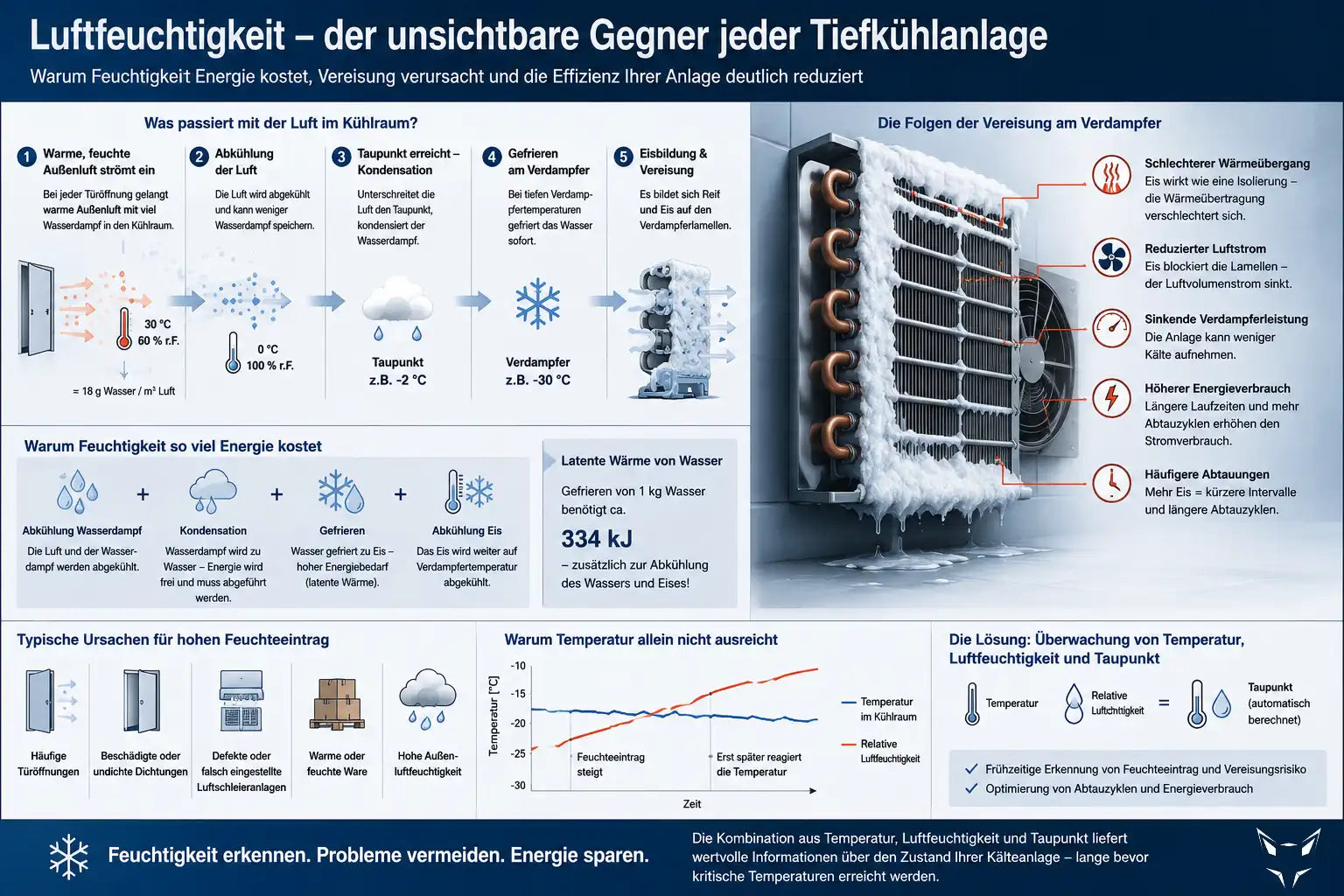
Temperature is important – but it only tells half the story.
If you ask operators of refrigeration or freezing systems about the most important measured value, the answer is almost always: The temperature.
After all, it determines whether food, pharmaceuticals, or other temperature-sensitive products are stored safely.
From a thermodynamic point of view, however, temperature is merely the result of many processes within a refrigeration system. The real "invisible enemy" is often humidity.
This is because every gram of water vapor that enters a refrigerated or freezer room must be laboriously processed by the refrigeration system. This process consumes considerable amounts of energy, leads to evaporator icing, and, in the long term, reduces the efficiency of the entire system.
Heat is not always the same as heat
Many operators assume that a refrigeration system only needs to cool down warm air.
In reality, however, air has a comparatively low heat capacity and mass. Most of the cooling load comes from elsewhere.
During a heatwave, the following heat up:
- the building envelope,
- walls and ceilings,
- concrete floors,
- shelving systems,
- packaging,
- conveyor technology,
- incoming goods,
- as well as all furnishings.
All these materials store thermal energy and continuously release it into the cold room.
At the same time, the heat flow through the building envelope increases.
The heat input can be simplified with the following equation:
Q̇ = U · A · ΔT
The greater the temperature difference between the inside and outside of a cold room, the greater the heat input.
A freezer room with an internal temperature of -20 °C already has a temperature difference of 40 Kelvin at an ambient temperature of 20 °C.
If the ambient temperature rises to 40 °C, this difference increases to 60 Kelvin.
The heat input through the same wall theoretically increases by about 50 %.
The refrigeration system must continuously absorb this additional energy and release it back into the environment via the condenser.
However, air not only transports heat – but also water
Humidity is even more critical.
Warm air can absorb significantly more water vapor than cold air.
If the door of a freezer room opens on a warm summer day, not only warm air but also a large amount of water vapor enters the cold room at the same time.
And it is precisely this water vapor that becomes the real problem.
What happens to the water vapor?
As soon as the warm outside air hits the evaporator, several thermodynamic processes occur one after another.
1. Cooling of the air
First, the air is cooled down.
As the temperature drops, its ability to store water vapor decreases.
2. Reaching the dew point
If the dew point is undershot, the water vapor begins to condense.
The gaseous water vapor turns back into liquid water.
This phase transition alone releases considerable amounts of energy that must also be absorbed by the evaporator.
3. Freezing
Since the surface temperature of an evaporator in a freezer system is often between -25 °C and -35 °C, the resulting water freezes immediately.
First hoarfrost forms, and then ice on the fins.
4. Further cooling
The process does not end even after that.
The resulting ice must then also be cooled down to the evaporator temperature.
Each of these steps requires additional cooling capacity.
Why humidity costs significantly more energy than dry air
The pure cooling of dry air accounts for only a comparatively small part of the total cooling load.
The phase transitions of water are significantly more energy-intensive.
Every gram of water vapor must be:
- cooled,
- condensed,
- frozen,
- and then further cooled down to storage temperature.
It is precisely this so-called latent heat that represents a significant proportion of the total cooling load.
That's why humid summer air often places a significantly greater burden on a freezer system than dry winter air – even if the temperature only differs by a few degrees.
Why evaporators ice up faster in summer
The evaporator is the coldest point of the entire system.
Almost all of the water vapor that enters the cold room therefore precipitates there.
With each door opening, the ice layer on the fins grows.
This icing acts like additional insulation.
This worsens the heat transfer between air and evaporator.
In addition, the air volume flow decreases as the free flow cross-section becomes smaller and smaller.
The consequences are:
- decreasing evaporator performance,
- longer compressor run times,
- more frequent defrost cycles,
- increasing energy consumption,
- decreasing COP of the entire system.
Thus, an initially small moisture ingress gradually develops into a thermodynamic vicious circle.
Why temperature alone is often not enough
Many systems still maintain their target temperature without problems for a long time.
Nevertheless, the system status changes much earlier.
Increasing humidity initially leads to:
- increasing icing,
- more frequent defrosts,
- longer compressor run times,
- higher energy consumption.
Only much later does the product temperature also begin to rise slowly.
Therefore, anyone who only monitors the temperature often recognizes this development relatively late.
Why temperature, humidity, and dew point belong together
Only the combination of these three measured values allows for a sound assessment of the system status.
The dew point can be calculated from temperature and relative humidity.
The dew point describes the temperature at which water vapor begins to condense.
If the surface temperature of an evaporator is below this value, condensate forms – in the case of freezer systems, immediate hoarfrost or ice.
The dew point therefore provides important information about the probability of increasing icing.
Early detection instead of late reaction
For precisely this reason, the LoRaFOXX temperature and humidity sensors measure not only the temperature but also the relative humidity.
In the PolarFOXX Cloud, these measured values are continuously evaluated and the dew point is automatically calculated.
This allows changes in system behavior to be detected much earlier than through temperature alone.
A continuous increase in humidity or a change in the dew point can indicate, for example:
- frequent door openings,
- damaged door seals,
- defective air curtain systems,
- increased moisture ingress,
- increasing icing,
- inefficient defrost cycles,
- or declining system performance
– long before critical product temperatures are reached.
These early insights, in particular, make it possible to plan maintenance measures precisely, reduce energy losses, and avoid unplanned system downtimes.
Outlook: From temperature monitoring to intelligent system monitoring
The digitization of refrigeration systems is increasingly developing from pure temperature documentation to condition-based monitoring.
The combination of temperature, humidity, dew point, and intelligent evaluations will in the future enable early detection of changes in system status and warn operators of increasing energy consumption or growing icing.
Because temperature often only shows the result.
The actual cause usually begins much earlier – with humidity.
Conclusion
Temperature remains one of the most important measured variables in refrigeration technology.
However, anyone who wants to assess the actual condition of a refrigeration or freezer system should always also consider humidity and the calculated dew point.
Only the interplay of these measured variables enables early detection of thermodynamic changes, reduction of icing, and sustainable improvement of the energy efficiency of a refrigeration system.
Because often, temperature is not the real problem.
But the water invisibly contained in the air.
Share:
Why a Heatwave Puts Multiple Stresses on Refrigeration Systems
Temperature monitoring is not a duty – it's an investment that pays off